Uncategorized
The Impact of VAR on Fan Experience: Accuracy vs. Atmosphere
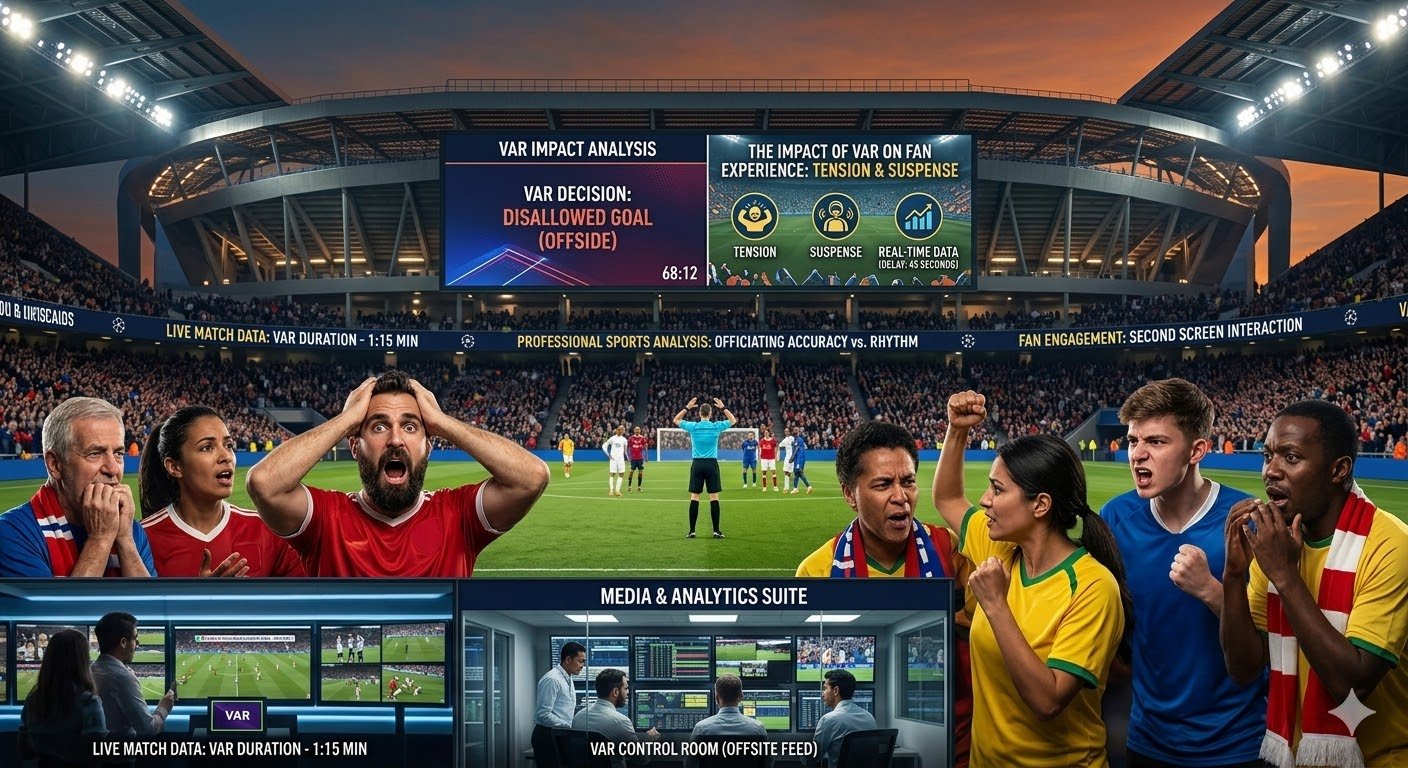
The introduction of the Video Assistant Referee (VAR) into professional football was promised as a revolution for fairness—a digital safeguard against the “clear and obvious errors” that have haunted the sport for decades. However, The Impact of VAR on Fan Experience has proven to be one of the most polarizing topics in modern sports history. While the statistical accuracy of match-changing decisions has undoubtedly climbed to nearly 99%, the emotional price paid by those in the stands and watching at home remains a fierce point of debate. This article explores how technology has fundamentally altered the way we consume the beautiful game, balancing the quest for justice against the preservation of football’s unique rhythm.
The Evolution of Video Match Officials
Football was famously late to the technological party. While cricket had the Decision Review System (DRS) and rugby utilized the Television Match Official (TMO), football relied on the human eye until 2018. The implementation of video replay technology through the VAR room was designed to assist the on-field referee in four specific match-changing situations: goals, penalty decisions, direct red cards, and mistaken identity.
Initially, the goal was “minimal interference, maximum benefit.” Yet, as we move into the 2025/26 season, the scope of the video operation room (VOR) has expanded. Fans now find themselves in a landscape where every celebration is conditional, and every tackle is scrutinized by high-definition cameras and slow-motion replays.
Measuring The Impact of VAR on Fan Experience
To understand the current state of the game, we must look at how supporters actually feel. Recent sentiment analysis suggests a deep divide between “home viewers” and “match-going fans.”
1. The Stadium Disconnect
For supporters in the stadium, the impact is often felt through silence and confusion. Unlike TV viewers who see multiple angles and hear commentator analysis, stadium attendees are often left staring at a big screen that simply reads: “VAR Check In Progress.”
-
Lack of Communication: Without real-time audio from the referee communication system, fans are often unaware of what is being checked.
-
The Death of Spontaneity: The “instant” joy of a goal has been replaced by a nervous glance toward the referee.
-
Atmospheric Dampening: Long delays for marginal offside calls can kill the momentum of a high-stakes match.
2. The Broadcast Advantage
Conversely, the impact of VAR on fan experience for those watching on television is slightly more nuanced. Broadcasters now provide:
-
Picture-in-Picture Replays: Viewers see what the VAR sees in real-time.
-
Expert Analysis: Former referees provide immediate context on subjective interpretations.
-
Semi-Automated Graphics: Clear visuals that explain why a goal was overturned.
Technical Precision and the “Toenail” Offside
One of the biggest hurdles in maintaining a positive fan experience has been the pursuit of “perfect” accuracy. The introduction of Semi-Automated Offside Technology (SAOT) for the 2025/26 season aims to address this.
-
Speed of Decision: SAOT can reduce offside check times by an average of 30 seconds.
-
Limb-Tracking Cameras: Using 12-30 dedicated cameras to track 29 data points on a player’s body.
-
Consistency: Removing the manual “drawing of lines” by humans, which was a major source of fan frustration.
However, even with better technology, the “toenail offside” remains a point of contention. Fans argue that being a centimeter offside does not provide a “sporting advantage,” yet the laws of the game demand technical perfection. This conflict between the letter of the law and the spirit of the game is central to the ongoing debate.
The Psychology of the “Clear and Obvious” Error
The threshold for intervention is perhaps the most misunderstood aspect of the Impact of VAR on Fan Experience. The original protocol stated VAR should only intervene for “clear and obvious errors.”
In practice, the definition of “clear and obvious” has shifted. Fans often complain about inconsistent implementation—where a foul is deemed a penalty in one match but ignored in another. This subjectivity leads to a perception of “re-refereeing” the game from a booth miles away, undermining the authority of the official on the pitch.
Why Fans Feel Frustrated:
-
Lengthy Reviews: Checks taking over three minutes disrupt the effective playing time.
-
Subjectivity: Decisions on handball interpretations or “intensity” of a foul remain human opinions, even with video.
-
Over-Analysis: Slow-motion replays can make a minor contact look like a violent foul, distorting the reality of the incident.
Transparency Improvements for 2025/26
Recognizing the growing friction, governing bodies like IFAB and the Premier League have introduced measures to improve the Impact of VAR on Fan Experience.
| Feature | Impact on Fan Experience | Status (2025/26) |
| Stadium Announcements | Referees explain the final decision over the PA system. | Fully Implemented |
| Big Screen Replays | Showing the definitive angle of an overturn to fans in the stands. | Mandatory |
| Live Referee Audio | Pilot programs to broadcast the conversation between VAR and the Ref. | In Trials |
| SAOT Integration | Faster, automated offside decisions with 3D graphics. | Standardized |
The Economic Reality of VAR
While many traditionalists call to “scrap VAR,” the financial stakes of modern football make that unlikely. A single incorrect decision can cost a club millions in broadcast revenue, sponsorship deals, or league positioning.
-
Integrity of the Competition: Sponsors and broadcasters demand a “fair” product.
-
Reduced Corruption Risk: Video trails make it significantly harder for match-fixing to influence outcomes.
-
Global Standard: As the world’s most-watched sport, football must maintain a standard of officiating comparable to other elite leagues.
The Future: AI and Beyond
As we look forward, the impact of VAR on fan experience will likely improve as Artificial Intelligence takes a larger role. We are moving toward a future where:
-
Instantaneous Checks: AI will detect fouls and offsides in milliseconds.
-
Interactive Fan Apps: Stadium fans can view the VAR feed directly on their smartphones.
-
Wearable Integration: Referees may wear cameras to provide a first-person perspective of the incident.
Conclusion: Balancing Fairness and Fun
The Impact of VAR on Fan Experience is a story of growing pains. We are currently in a transition period where the technology is capable of incredible precision, but the “human element” of the fan experience is still being refined.
For the game to thrive, the focus must shift from officiating accuracy alone to officiating efficiency. Fans are generally willing to accept technology if it is fast, transparent, and used only for the most egregious mistakes. As transparency increases and decision times decrease, the “new normal” of football may finally start to feel like the beautiful game again.
Frequently Asked Questions (FAQs)
1. Does VAR actually make the game more accurate?
Yes. Statistics from FIFA and major leagues like the Premier League show that the percentage of correct “key match decisions” has risen from approximately 82% (without VAR) to over 98% with it. While it isn’t perfect, it has removed hundreds of blatant errors.
2. Why can’t fans hear the VAR officials talking during the game?
Currently, IFAB rules prohibit the live broadcast of the audio between the referee and the VAR during the match to protect the officials from excessive pressure. However, many leagues are now releasing “Match Officials Mic’d Up” segments post-match to improve transparency.
3. Will Semi-Automated Offside Technology (SAOT) eliminate all delays?
It won’t eliminate all delays, but it significantly reduces them. SAOT handles the “objective” part of the offside—the position of the players. The VAR still has to manually confirm if an offside player was “interfering with play,” which is a subjective decision.
4. Why does VAR check every goal even when there is no obvious foul?
The protocol requires a “silent check” of every goal to ensure the integrity of the game. Most of these checks happen in the background while players are celebrating and do not lead to a formal “review” or delay.
5. Can a captain request a VAR review like in tennis or cricket?
No. Football does not currently have a “challenge system.” The decision to review an incident rests solely with the VAR and the on-field referee. This is to prevent teams from using challenges as a time-wasting tactic.
Uncategorized
Inter Miami vs Tigres UANL Timeline, Results & Lineups
The cross-border rivalry between Major League Soccer (MLS) and Liga MX has found a thrilling new chapter. When evaluating the brief but incredibly intense inter miami vs tigres uanl timeline, football fans recognize a matchup defined by tactical chess matches, passionate fanbases, and dramatic finishes.
While Inter Miami CF has quickly elevated its global profile through legendary signings, Tigres UANL represents the old-guard royalty of Mexican football. The teams have faced each other in high-stakes tournament settings, delivering almost identical levels of drama each time they step onto the pitch.
Here is the complete historical breakdown, tactical analysis, and individual performances that define this growing North American football rivalry.
The Complete Inter Miami vs Tigres UANL Timeline
The historical record between these two clubs is brief but impactful. They have met exclusively in the tigres vs miami leagues cup tournament, a competition designed specifically to pit the best of MLS against the elite of Liga MX.
[August 3, 2024] Group Stage: Tigres UANL 2 - 1 Inter Miami CF (NRG Stadium)
[August 20, 2025] Quarterfinal: Inter Miami CF 2 - 1 Tigres UANL (Chase Stadium)
Both encounters ended in identical 2-1 scorelines, with the home-field climate and tournament progression shifting the balance of power each year.
August 20, 2025: Leagues Cup Quarterfinal Drama at Chase Stadium
Their most recent encounter took place in the knockout stages of the competition. With a spot in the semifinals on the line, Inter Miami hosted the Mexican giants in Fort Lauderdale, Florida. The match quickly devolved into a physical, tactical battle dictated by fine margins and penalty box composure.
-
23′ – The Opener: Inter Miami established early dominance through controlled possession. After a clumsy challenge inside the penalty box by the Tigres defense, veteran striker Luis Suárez calmly converted from the penalty spot to make it 1-0.
-
67′ – The Equalizer: Tigres shifted their tactical structure in the second half, pushing their wingbacks higher up the pitch. The pressure paid off when Juan Brunetta delivered a precise assist to Ángel Correa, who slipped the ball past the Miami keeper to level the score at 1-1.
-
89′ – The Winner: Just as extra time felt inevitable, another defensive lapse from Tigres under immense pressure forced the referee to point to the spot for a second time. Luis Suárez stepped up in the dying minutes, sending the goalkeeper the wrong way to secure a dramatic 2-1 victory and send Miami to the tournament semifinals.
This crucial victory allowed Inter Miami to avenge their previous defeat against the Monterrey-based club, cementing their status as true continental contenders.
August 3, 2024: Leagues Cup Group Stage Battle in Houston
A year prior to their quarterfinal thriller, the two sides met at a neutral site—Houston’s NRG Stadium—for a highly anticipated group stage match. The atmosphere was electric, split evenly between local MLS supporters and traveling Liga MX enthusiasts looking for tigres vs miami today updates.
-
17′ – Early Blood: Tigres caught the Miami backline sleeping early in the first half. Midfielder Juan Brunetta capitalized on a loose ball at the edge of the area, striking a world-class half-volley into the top corner to give the Mexican side a 1-0 advantage.
-
74′ – Miami Fights Back: Inter Miami controlled the bulk of the second-half possession, searching for an opening. Ecuadorian forward Leonardo Campana was brought down inside the box, earning a penalty. Campana converted the spot-kick himself, making history by tying Gonzalo Higuaín as the club’s joint all-time leading goalscorer at the time.
-
84′ – The Decisive Blow: The joy was short-lived for the South Florida club. Tigres demonstrated their tournament pedigree, launching a swift counter-attack that concluded with midfielder Juan Pablo Vigón smashing home the game-winning goal, securing top spot in the group for the visitors.
Head-to-Head Tactical Analysis & Formations
When analyzing the inter miami vs tigres uanl lineups, both managers had to balance defensive stability with explosive transition play.
Inter Miami CF Tactical Approach
During their recent matches, Inter Miami relied heavily on a progressive 4-3-3 system that occasionally shifted into a defensive 5-3-2 when protecting a lead. The midfield engine room, marshaled by the timeless positioning of Sergio Busquets, focused on dictating the tempo and unlocking spaces for overlapping fullbacks like Jordi Alba.
The primary attacking strategy revolved around feeding the clinical runs of Luis Suárez, who proved to be the ultimate difference-maker in tight knockout situations.
Tigres UANL Tactical Approach
Tigres brought a classic Liga MX pragmatism to the pitch. Operating out of a disciplined 4-2-3-1 formation, their game plan relied on midfield defensive anchors like Guido Pizarro and Rafael Carioca to disrupt Miami’s rhythm.
In transition, Tigres utilized the creative spark of Juan Brunetta to pull center-backs out of position, allowing dynamic forwards like André-Pierre Gignac and Ángel Correa to exploit vertical channels.
Inter Miami vs Tigres UANL Player Ratings
Individual brilliance ultimately decided both matches in the inter miami vs tigres uanl timeline today. Here is how the key players rated during their historic 2025 quarterfinal matchup.
| Player | Position | Team | Match Rating | Key Match Contribution |
| Luis Suárez | Forward | Inter Miami | 8.5 | Scored two clinical penalties to secure the 2-1 knockout victory. |
| Ian Fray | Defender | Inter Miami | 7.8 | Executed critical defensive recoveries against veteran Liga MX forwards. |
| Ángel Correa | Forward | Tigres UANL | 7.4 | Scored a phenomenal second-half goal to briefly equalize the game. |
| Yannick Bright | Midfielder | Inter Miami | 7.4 | Covered immense ground in midfield to disrupt the creative flow of Brunetta. |
| Juan Brunetta | Midfielder | Tigres UANL | 7.0 | Provided the crucial assist for Correa’s goal and created three chances. |
-
Perfect Symmetry: The head-to-head record between Inter Miami and Tigres UANL sits perfectly balanced with one victory apiece, both matches concluding in hard-fought 2-1 scorelines.
-
The Penalty Factor: Spot-kicks have defined this specific fixture, with three of the six total goals scored across both matches originating directly from the penalty spot.
-
Tournament Stakes: This fixture has quickly developed into a marquee rivalry for the tournament, showcasing the minimal gap in competitive quality between elite MLS and Liga MX teams.
Looking Ahead: Inter Miami vs Tigres UANL Prediction
Future iterations of this cross-border matchup will likely depend on roster depth and physical fitness. Any realistic inter miami vs tigres uanl prediction will always favor the team that can manage late-game fatigue under intense summer tournament conditions.
Because both sides possess highly technical midfields and world-class veteran strikers, future games are predicted to remain incredibly close, low-scoring affairs where tactical mistakes are punished instantly.
For global football fans interested in tracking international rosters, securing tickets for high-profile matches, or getting early access to continental tournaments, exploring the FIFA Visa Presale details offers an excellent head start. Additionally, keeping tabs on world football tickets like the Mexico vs South Africa tickets hub or monitoring foreign squads like the Saudi Arabia football squad provides fantastic context on how clubs construct internationally competitive rosters.
To explore more comprehensive football schedules, tournament breakdowns, and deep tactical analyses across global leagues, visit the home of comprehensive football coverage at FIFA World.
Conclusion
The budding rivalry between Inter Miami and Tigres UANL highlights the rapid competitive growth of North American club football. Through two dramatic Leagues Cup encounters, both teams have proved that matches between MLS and Liga MX giants are decided by individual composure and elite coaching adjustments. As both clubs continue to chase continental trophies, their head-to-head history promises to provide many more unforgettable moments for football fans across the continent.
Frequently Asked Questions (FAQ)
1. What is the overall head-to-head record between Inter Miami and Tigres UANL?
The overall head-to-head record is perfectly tied. Out of two total matches played in tournament history, Tigres UANL won the first encounter 2-1 in 2024, and Inter Miami won the second match 2-1 in 2025.
2. Who scored the winning goal in the most recent match?
Luis Suárez scored the winning goal for Inter Miami in the 89th minute of their August 20, 2025, quarterfinal match by calmly converting his second penalty kick of the evening.
3. Have these two teams ever played a match in Mexico?
No, both official matches in the tigres uanl vs inter miami live score history have taken place in the United States. The 2024 match was hosted at NRG Stadium in Houston, Texas, while the 2025 match took place at Chase Stadium in Fort Lauderdale, Florida.
4. Did Leonardo Campana make history against Tigres UANL?
Yes, during the August 3, 2024 group stage match in Houston, Leonardo Campana scored a 74th-minute penalty kick that tied him with Gonzalo Higuaín as Inter Miami’s all-time leading goalscorer with 29 goals at that point in club history.
5. In which competition do Inter Miami and Tigres play against each other?
Inter Miami and Tigres UANL compete against each other in the Leagues Cup, which is an official, month-long summer tournament that features every single club from Major League Soccer and Liga MX.
Uncategorized
Understanding 19.2.1 balloons codehs in Programming Education
Programming education is becoming more important for students who want to build strong technical skills and understand modern software systems. Platforms like CodeHS make coding easier by offering interactive exercises, real coding projects, and beginner-friendly lessons. One popular activity that students search for is 19.2.1 balloons codehs, which focuses on creativity, logic building, and software feature understanding.
This topic is useful for beginners because it combines simple coding concepts with visual learning. Students can practice how software features work while learning to manage shapes, colors, positions, and loops in a coding environment. These types of projects improve logical thinking and help students understand how real applications are designed.
Why Coding Education Matters Today
Coding education is no longer limited to software engineers. Schools, colleges, and online learning platforms now encourage students to learn programming because technology is connected to almost every industry.
Programming helps students:
- Improve logical thinking
- Build problem-solving skills
- Understand software development
- Create interactive applications
- Learn modern technology concepts
Platforms like CodeHS provide step-by-step lessons that make coding simple for beginners. Students can practice directly in the browser without downloading complex software.
For students interested in learning more about online topics and digital updates, these useful resources may help:
- urlFIFA World UK Homehttps://fifaworld.co.uk/
- urlLatest Blog Updateshttps://fifaworld.co.uk/blog/
- urlSports News Categoryhttps://fifaworld.co.uk/category/sport-news/
- urlExtra Resource Pagehttps://fifaworld.co.uk/__trashed/
How CodeHS Helps Beginners Learn Programming
CodeHS is an online platform designed for students and teachers who want to learn programming in an easy and interactive way. The platform includes exercises related to JavaScript, Python, HTML, CSS, and other coding languages.
One reason students like CodeHS is because it uses practical activities instead of only theory. Visual exercises help learners understand how code changes objects on the screen.
Some important software features of CodeHS include:
- Browser-based coding environment
- Interactive coding challenges
- Progress tracking system
- Beginner-friendly lessons
- Real-time code testing
- Educational video tutorials
These features make programming education more engaging and easier to understand.
Understanding the Balloons Activity in CodeHS
The balloons activity in CodeHS is designed to help students understand graphical programming concepts. In this task, learners usually create balloons using shapes, colors, loops, and coordinates.
Students practice how to:
- Draw shapes using code
- Change object positions
- Apply colors and sizes
- Use loops for repeated actions
- Understand coordinate systems
This activity may look simple, but it teaches important programming fundamentals used in real software applications and game development.
Basic Skills Students Learn
When students work on balloon-related projects, they develop several important coding skills.
Object Positioning
Students learn how objects appear on the screen using X and Y coordinates. This is an essential concept in software development and computer graphics.
Loop Usage
Loops allow programmers to repeat actions without writing the same code again and again. This improves coding efficiency.
Creative Problem Solving
Students can experiment with different balloon sizes, colors, and placements. This improves creativity while practicing coding logic.
Key Benefits of Learning Programming Through Visual Projects
Visual coding projects help beginners understand difficult concepts more easily. Instead of reading theory only, students can instantly see how their code changes the output.
Important Learning Points
- Visual coding improves programming understanding faster.
- Interactive projects help students stay motivated.
- Software feature practice builds real-world coding confidence.
Software Features That Support Coding Education
Modern coding platforms include many software features that improve the learning experience. These features help both students and teachers manage coding lessons efficiently.
Real-Time Error Detection
Most coding platforms instantly highlight mistakes. This helps students fix errors quickly and understand debugging.
Interactive Learning Environment
Interactive editors allow users to test their code immediately. This creates faster learning feedback.
Cloud-Based Access
Students can access coding lessons from any device with an internet connection. There is no need for heavy software installation.
Progress Monitoring
Teachers can monitor student progress, assignments, and coding performance through dashboards.
Why Beginners Should Practice Creative Coding Activities
Creative coding projects help students avoid boredom during learning. Many beginners lose interest when lessons become too theoretical.
Activities like balloon animations, simple games, and graphical designs keep students motivated while teaching important concepts.
These projects also prepare learners for advanced topics such as:
- Web development
- Game development
- Mobile app design
- User interface creation
- Software engineering
Students who regularly practice coding projects usually improve faster than students who only read tutorials.
Best Resources for Learning Programming Online
Students can improve coding knowledge through trusted online platforms and educational websites.
Useful outbound learning resources include:
- urlCodeHS Official Websitehttps://codehs.com/
- urlMDN Web Docshttps://developer.mozilla.org/
- urlW3Schools Programming Tutorialshttps://www.w3schools.com/
- urlfreeCodeCamp Learning Platformhttps://www.freecodecamp.org/
These websites provide beginner-friendly lessons, coding examples, and programming practice projects.
Common Challenges Faced by Beginner Programmers
Many students feel confused when they start coding for the first time. Programming requires patience and regular practice.
Understanding Syntax
Every programming language has rules called syntax. Small mistakes can stop the program from working.
Debugging Errors
Beginners often struggle to find mistakes in their code. Debugging becomes easier with practice.
Building Logic
Programming is not only about writing code. Students must learn how to solve problems step by step.
Staying Consistent
Regular coding practice is necessary for improvement. Students who practice daily usually learn faster.
How Coding Skills Help Future Careers
Programming skills are now valuable in many industries, not only software companies.
Careers connected with coding include:
- Software developer
- Web designer
- Data analyst
- Game developer
- Cybersecurity specialist
- Mobile app developer
Even basic coding knowledge can help students understand technology better and improve future job opportunities.
Conclusion
Programming education is becoming one of the most valuable skills for students worldwide. Activities like CodeHS balloon projects help beginners understand software features, logic building, and visual coding in an engaging way. Creative exercises improve confidence and make coding easier to learn. By practicing regularly and using trusted learning platforms, students can develop strong programming skills that support future education, software development, and technology careers in a modern digital world.
Frequently Asked Questions
What is CodeHS used for?
CodeHS is an online learning platform that teaches programming and computer science through interactive lessons and coding exercises.
Why are visual coding projects important?
Visual coding projects help beginners understand programming concepts more easily by showing real-time output on the screen.
Can beginners learn coding without experience?
Yes, beginners can learn coding without previous experience by using beginner-friendly platforms and practicing regularly.
Which programming languages can students learn online?
Students can learn Python, JavaScript, HTML, CSS, Java, and many other programming languages online.
How does coding help future careers?
Coding improves problem-solving skills and opens opportunities in software development, web design, cybersecurity, and technology-related careers.
Uncategorized
The Ultimate Guide to LEDFVSDRV: Mastering Forward Voltage Control in Series LED Driver Systems
The landscape of solid-state lighting has shifted from simple illumination to a precise science of power management. At the heart of this evolution is LEDFVSDRV—a technical shorthand for LED Forward Voltage Series Driver architectures. For engineers, lighting designers, and high-end DIYers, understanding how to manage the relationship between forward voltage ($V_f$) and series-driven arrays is the difference between a system that lasts 50,000 hours and one that fails in five.
What, Who, Where, and Why: The LEDFVSDRV Essentials
To reduce the “bounce rate” of your project’s success, let’s define the core parameters immediately:
-
What is it? LEDFVSDRV refers to the specific methodology of driving Light Emitting Diodes (LEDs) in a series string where the driver dynamically compensates for the cumulative Forward Voltage ($V_f$) of the array.
-
Who needs it? Electrical engineers, automotive lighting designers (where vibration and heat are factors), and architectural lighting specialists.
-
Where is it used? You’ll find these systems in everything from high-intensity automotive headlamps and stadium floodlights to the backlight units (BLUs) of your 4K television.
-
Why does it matter? Traditional parallel circuits often suffer from “current hogging,” where one LED draws more power than others, leading to thermal runaway. A series driver (SDRV) ensures every LED in the string receives the exact same current, maximizing color consistency and lifespan.
-
How does it work? The driver monitors the output voltage and adjusts the duty cycle or internal switching frequency to maintain a constant current, even as the LEDs heat up and their $V_f$ fluctuates.
Understanding the Core Architecture of LEDFVSDRV
In a standard LED system, the “Forward Voltage” is the minimum amount of voltage required to get current to flow across the diode and produce light. When we talk about LEDFVSDRV, we are focusing on the Series (S) configuration.
The Physics of the Series String
In a series circuit, the total voltage required is the sum of the $V_f$ of each individual LED.
If you are running ten LEDs with a $V_f$ of $3.2V$ each, your driver needs to provide at least $32V$ plus a small “overhead” voltage for the driver’s internal regulation. This is where the “DRV” (Driver) component becomes sophisticated. Unlike a simple resistor, a modern LEDFVSDRV integrated circuit (IC) uses a boost or buck-boost topology to step the input voltage up or down to match this requirement perfectly.
Why Forward Voltage (Vf) is a Moving Target
One common misconception in the field is that $V_f$ is static. It isn’t. Forward voltage has a negative temperature coefficient. As the LED junction temperature rises, the $V_f$ actually drops.
-
Cold Start: High $V_f$, lower current draw (if voltage is fixed).
-
Operating Temp: Lower $V_f$, potentially higher current draw.
If you used a constant voltage power supply, the drop in $V_f$ would cause the current to spike, leading to “thermal runaway.” An LEDFVSDRV system prevents this by sensing the current through a feedback loop and adjusting the voltage in real-time to keep the current (Amps) rock-solid.
Key Benefits of LEDFVSDRV in Modern Lighting
1. Superior Color Consistency (Binning Protection)
LEDs are “binned” at the factory based on their color temperature and $V_f$. However, even within the same bin, slight variations exist. By driving them in series, you ensure that the exact same number of electrons passes through every diode. Since brightness and chromaticity are primarily functions of current, a series driver guarantees that your $4000K$ light strip doesn’t look $3800K$ at one end and $4200K$ at the other.
2. Efficiency and Luminous Efficacy
Every milliwatt wasted as heat is a milliwatt not turned into photons. LEDFVSDRV systems typically utilize Switch-Mode Power Supply (SMPS) technology. By using high-frequency switching (often in the $600kHz$ to $1.2MHz$ range), these drivers achieve efficiencies upwards of 92-95%. This reduces the size of the required heat sinks and allows for more compact lighting fixtures.
3. Reduced Wiring Complexity
In parallel systems, you need thick gauge wire to handle high current. In a series LEDFVSDRV setup, the current remains low (e.g., $350mA$ or $700mA$) while the voltage increases. This allows for thinner, more flexible wiring, which is a massive advantage in aerospace and automotive applications where weight and space are premium.
Technical Implementation: How to Deploy LEDFVSDRV Systems
When selecting a driver for your LEDFVSDRV project, the package type and thermal management are your primary concerns.
Choosing the Right IC Package: WSON vs. SOT-23
For low-power applications, a SOT-23 package is common. However, for high-performance LEDFVSDRV implementations, engineers prefer the DRV (WSON) package. The WSON (Small Outline No-lead) package includes a Thermal Pad on the bottom. This pad must be soldered directly to the PCB’s copper plane to “wick” heat away from the silicon.
Pro Tip: The 10% Overhead Rule
Always select an LEDFVSDRV that has a maximum output voltage at least 10-15% higher than your calculated total $V_f$. This “headroom” ensures the driver remains in its linear regulation range even during cold starts or when dealing with power supply ripples.
Dimming Methodologies: PWM vs. Analog
Control is the second half of the driver equation. Most LEDFVSDRV ICs support two types of dimming:
-
Pulse Width Modulation (PWM): The driver rapidly turns the LEDs on and off. The human eye perceives the average light level. This is the gold standard for maintaining color accuracy at low brightness.
-
Analog (Linear) Dimming: The driver reduces the actual current. While simpler, this can cause “color shift” as the LED chemistry behaves differently at sub-nominal current levels.
Advanced Troubleshooting: Common Pitfalls in Series Arrays
Even with the best LEDFVSDRV hardware, things can go wrong. Here is how to diagnose the most common failures:
The “Flicker” Phenomenon
If your LED string is flickering, it’s often a sign of Voltage Headroom Insufficiency. If the input voltage drops slightly, and the driver is already at its maximum “Boost” capacity, it will lose regulation, causing the LEDs to pulse.
Ghosting and Leakage
In high-voltage series strings, you might see LEDs faintly glowing even when “off.” This is usually due to parasitic capacitance or leakage current within the driver. Using a driver with a dedicated EN (Enable) pin that physically disconnects the output is the best solution.
Open-Circuit Protection
What happens if one LED in the string fails? In a series circuit, one failure usually kills the whole string. However, advanced LEDFVSDRV chips feature Over-Voltage Protection (OVP). If an LED goes “open,” the driver detects a sudden spike in voltage (as it tries to force current through an infinite resistance) and shuts down safely to prevent the IC from exploding.
The Future of LEDFVSDRV: Smart Drivers and DALI
As we move toward 2027 and beyond, the “DRV” part of LEDFVSDRV is getting “smarter.” We are seeing the integration of DALI (Digital Addressable Lighting Interface) directly into the driver silicon.
-
Bi-directional Communication: The driver doesn’t just receive commands; it sends data back. It can report its internal temperature, total run hours, and even predict an LED failure before it happens by monitoring subtle shifts in the $V_f$ signature.
-
Adaptive Efficiency: Newer drivers can detect the input AC frequency and adjust their Power Factor Correction (PFC) in real-time, ensuring they remain “green” regardless of the local power grid quality.
Conclusion: Why LEDFVSDRV is the Industry Standard
Mastering LEDFVSDRV isn’t just about making lights turn on; it’s about the precision engineering of energy. By prioritizing series configurations and respecting the nuances of Forward Voltage, you create lighting systems that are more efficient, more durable, and visually superior. Whether you are designing the next generation of EV headlights or a bespoke architectural installation, the principles of constant current and thermal management remain your most important tools.
Frequently Asked Questions (FAQ)
What is the difference between a constant voltage driver and an LEDFVSDRV?
A constant voltage driver maintains a steady voltage (e.g., $12V$), which is dangerous for LEDs without resistors. An LEDFVSDRV (Constant Current Series Driver) maintains a steady current (e.g., $350mA$) by automatically adjusting the voltage to match the LEDs’ needs.
Can I use an LEDFVSDRV with parallel LED strings?
It is not recommended. If one parallel string fails, the driver will force the full current through the remaining strings, likely causing them to burn out instantly. For parallel setups, you need individual current-limiting for each branch.
Does Forward Voltage ($V_f$) increase or decrease with heat?
Forward voltage decreases as heat increases. This is why constant current drivers are essential; they reduce the voltage to ensure the current doesn’t skyrocket as the LEDs warm up.
What is “PWM Dimming” in the context of LED drivers?
PWM dimming stands for Pulse Width Modulation. It turns the LED on and off at high frequencies (thousands of times per second). By changing the “on” time vs. the “off” time, the driver changes the perceived brightness without changing the color temperature.
How do I calculate the power supply needed for an LEDFVSDRV?
Multiply the current (in Amps) by the total $V_f$ of your string. For example: $0.7A \times 32V = 22.4 Watts$. Choose a power supply that can provide at least $25-30W$ for safety.
Schema Markup (JSON-LD) for FAQ:
(Note: For web implementation, wrap the above FAQ in the following schema script for enhanced Google search visibility)
-
Blog2 weeks agoBeyond the Buttons: under growth games uggcontroman controller Controller Philosophy
-
Blog1 month agoGia Derza “Leaked Video” Search Trend: What It Really Means, Risks, and the Truth Behind Viral Content
-
Business1 month agoThe Ultimate Guide to Adventureppctop.com Business License: Transparency and Compliance in Digital Advertising
-

Blog1 month agoPragmatic Hoki22.com: A Technical Breakdown of RNG Mechanics and Payout Algorithms
-
Sports1 month agoSlot Gacor Microstar88.gcr: The Definitive 2026 Strategy Guide for High RTP Gaming
-
Uncategorized1 month agoThe Shift to Visibility-First Growth: A Deep Dive into SEO by Highsoftware99.com
-
Business1 month agotechmapz com: What It Is, Who It Helps, and Whether It’s Worth Your Time
-
Sport News1 month agoRaqball: Evolucija hibridnih sportova i nova era timske dinamike