
FIFA world Cup
Beyond the 90 Minutes: How Long is a Football Game?

If you ask a casual fan how long a football match lasts, they will likely give you a quick answer: “90 minutes.” While that’s the textbook definition found in the IFAB Laws of the Game, any seasoned supporter knows that the referee’s final whistle rarely blows at the 90:00 mark.
In the modern era—and looking ahead to the massive FIFA World Cup 2026 in North America—the duration of a game has become a complex calculation involving video reviews, tactical time-wasting, and a global push for more “active” minutes on the pitch. Whether you are a bettor looking at “stoppage time” markets or a fan planning your travel to host cities like Toronto or Mexico City, understanding the nuances of the football clock is essential.
The Standard Structure: 90 Minutes of Regulation 226
The foundation of every professional match is the 90-minute regulation period. This duration was standardized in the late 19th century and has remained the gold standard for the sport.
The Two Halves
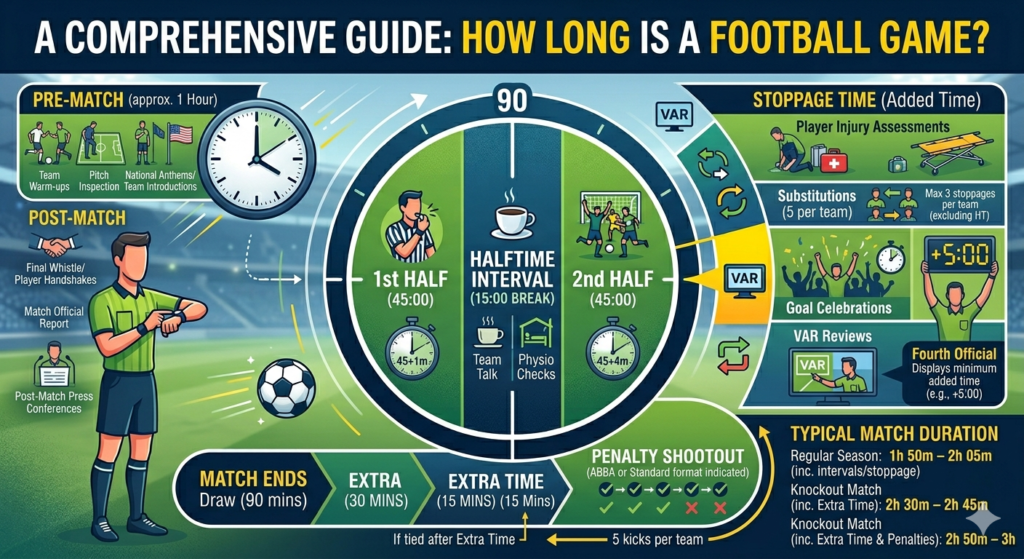
A game is divided into two 45-minute halves. Unlike American football or basketball, the clock in football is continuous. It does not stop when the ball goes out of bounds, when a goal is celebrated, or when a player is cautioned with a yellow card. This “running clock” is what necessitates the addition of time at the end of each period.
The Halftime Interval
The 15-minute halftime break is more than just a rest period. For managers like Pep Guardiola or Carlo Ancelotti, it is a high-pressure window for tactical overhauls. For players, it is a vital recovery phase. Under FIFA regulations, the halftime interval cannot exceed 15 minutes, though in some domestic competitions, it can be slightly shorter if agreed upon by both teams and the referee.
How Long is a Football Game
The Mystery of Stoppage Time (Added Time)
The most unpredictable part of a football game is Stoppage Time (often called injury time). This is the period added to the end of each 45-minute half to compensate for time lost during play.
Why is Time Added?
The fourth official, stationed on the touchline, holds up an electronic board indicating the minimum number of minutes to be added. The referee calculates this based on:
-
Substitutions: Traditionally 30 seconds per player swap.
-
Injuries: Assessment and removal of injured players.
-
Goal Celebrations: Often overlooked, but major celebrations can eat up 60–90 seconds.
-
VAR Checks: Video Assistant Referee reviews are the biggest factor in modern game extension.
-
Disciplinary Sanctions: Time taken to issue cards or manage player confrontations.
The “Collina Effect” and the 100-Minute Match
Since the 2022 World Cup in Qatar, FIFA’s refereeing committee, led by the legendary Pierluigi Collina, has pushed for much longer stoppage times. The goal is to ensure that fans get their money’s worth and that time-wasting is discouraged. It is now common to see 8 to 12 minutes of added time in the second half of major matches.
This trend is expected to be even more prominent during the FIFA World Cup 2026. With 48 teams competing in 104 matches across the USA, Canada, and Mexico, officials are under strict instructions to keep the “ball in play” for as long as possible.
Knockout Rounds: Extra Time and Penalties
In league matches (like the English Premier League or Major League Soccer), a game can end in a draw. However, in knockout tournaments, a winner must be decided.
How Long is a Football Game
Extra Time (Overtime)
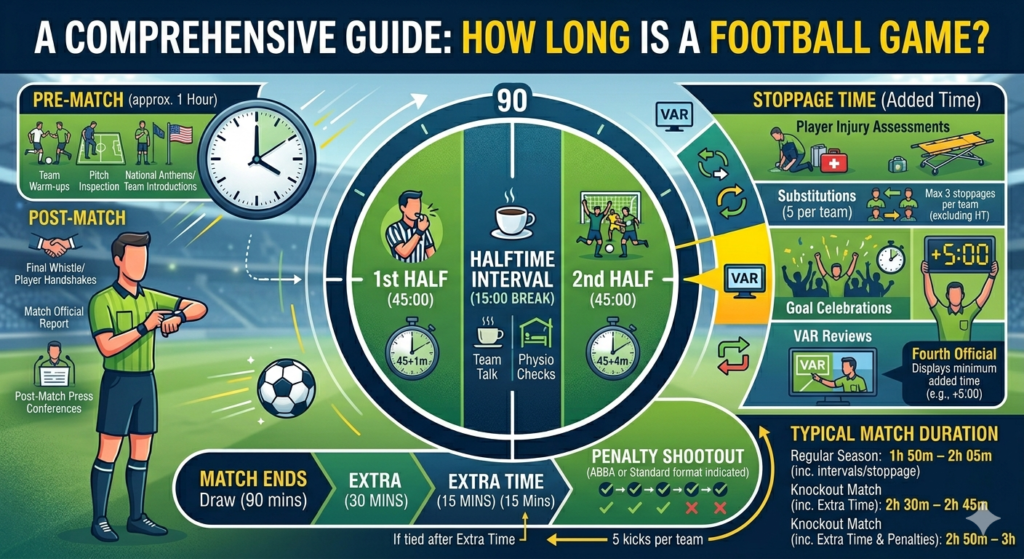
If the score is level after 90 minutes plus stoppage time in a knockout game, the match enters Extra Time. This consists of:
-
A short 5-minute break.
-
Two 15-minute halves of play.
-
A 1-minute break between these halves (usually just long enough to swap ends).
Crucially, there is no “Golden Goal” rule anymore. Both 15-minute periods must be played in full, regardless of how many goals are scored. This adds a guaranteed 30 minutes to the game, plus the inevitable stoppage time for each of those 15-minute segments.
The Penalty Shootout
If the deadlock remains after 120 minutes of grueling football, the match moves to a Penalty Shootout. While the shootout itself usually takes 10 to 15 minutes, the psychological tension makes it feel much longer. Each team takes five kicks; if they remain tied, it goes to “sudden death.”
New IFAB Rule Changes for 2026
The International Football Association Board (IFAB) recently met in February 2026 to ratify new rules aimed at speeding up the game. These changes directly impact how long you can expect to stay in your seat.
The 10-Second Substitution Rule
To combat the “slow walk” of a substituted player, IFAB has introduced a 10-second limit. If a player does not exit the pitch within 10 seconds of their number being shown, they face a yellow card, and the restart can be moved or penalized.
Restart Countdowns
Expect to see referees being much more aggressive with “reverse restarts.” If a player takes too long over a throw-in or a corner kick (exceeding a verbalized or signaled countdown), possession may be handed directly to the opponent. These “War on Time-Wasting” measures are designed to shrink the gap between the 90-minute clock and the actual duration the ball is moving.
Total Duration: A Reality Check
When you factor in everything, a “90-minute” game is almost never 90 minutes. Here is a breakdown of what a fan should actually expect:
| Match Phase | Minimum Time | Typical Time | Maximum (Knockout) |
| First Half | 45:00 | 48:00 | 52:00 |
| Halftime | 15:00 | 15:00 | 15:00 |
| Second Half | 45:00 | 52:00 | 58:00 |
| Extra Time | N/A | N/A | 35:00 (inc. breaks) |
| Penalties | N/A | N/A | 15:00 |
| Total | ~105 Mins | ~115 Mins | ~175 Mins |
Variability Across Different Levels of Football
Not every football game is 90 minutes. The duration scales based on the age and physical demands of the participants.
Youth Football (The Growing Years)
To prevent overexertion, youth matches are significantly shorter.
-
U17 & U18: Two 45-minute halves (Standard).
-
U15 & U16: Two 40-minute halves.
-
U13 & U14: Two 35-minute halves.
-
U11 & U12: Two 30-minute halves.
-
U9 & U10: Two 25-minute halves.
Women’s Professional Football
At the professional level (including the FIFA Women’s World Cup), the duration is identical to the men’s game: two 45-minute halves. The intensity and physical metrics in the women’s game have surged, leading to similar stoppage time patterns due to VAR and tactical substitutions.
Blind Football and Para-Sports
Adapted versions of the game often feature 25-minute halves with a 10-minute halftime. In these formats, the clock often does stop when the ball is out of play, similar to futsal, ensuring a specific amount of “effective playing time.”
What to Expect at FIFA World Cup 2026
The 2026 tournament will be a logistical beast. For the first time, the Cup will feature 48 teams and 16 host cities.
Scheduling and “The Clock”
With three host nations, matches will be played across four different time zones. FIFA is prioritizing “player welfare,” which means they are being very specific about kick-off times to maximize rest days. However, because of the high stakes, expect the “Collina Directive” to be in full force.
Referees at the MetLife Stadium (the venue for the Final on July 19, 2026) or the Azteca Stadium will likely add significant time for any perceived time-wasting. Fans should plan for at least 2.5 hours from kick-off to the final whistle for group stage matches, and up to 4 hours for knockout games that might go the distance.
The Impact of VAR in 2026
Technology is evolving. While semi-automated offside technology (SAOT) has made decisions faster, the overall “VAR check” process still adds an average of 2 to 3 minutes per game. In a high-stakes tournament, officials are encouraged to get the call right rather than get the call fast, which naturally extends the duration.
Why Timing Matters for Fans and Bettors
For those attending games in cities like Los Angeles or Dallas, knowing the end time is crucial for catching public transport or making dinner reservations.
For the betting community, “Total Minutes” and “Stoppage Time Goals” have become incredibly popular markets. The “Fergie Time” phenomenon—where goals are scored in the dying embers of a match—is now a statistical reality fueled by the fact that the “dying embers” now last 10 minutes instead of two.
Frequently Asked Questions (FAQs)
Does the clock stop when the ball goes out?
No, in professional association football, the clock runs continuously. The referee keeps track of lost time and adds it to the end of the half.
Is halftime included in the 90 minutes?
No. The 90 minutes refers only to the playing periods. The 15-minute halftime is an additional interval between the two 45-minute halves.
What is the longest football match ever played?
The record for the longest continuous football match is 168 hours (7 days), played by two teams in Germany in 2021 for charity. In professional play, games that go to extra time and penalties are the longest, usually clocking in around 120–140 minutes of actual match time.
Why do some games have 10+ minutes of added time?
This is usually due to a combination of long VAR reviews, multiple substitutions, significant injuries, or intentional time-wasting by players. FIFA’s recent directives aim to maximize the “active” time the ball is in play.
How long is a football game including commercials?
Unlike the NFL, football does not have commercial breaks during play. Commercials only run before the match, during halftime, and after the match. This is why the total broadcast window is usually about 2 hours and 15 minutes for a standard game.
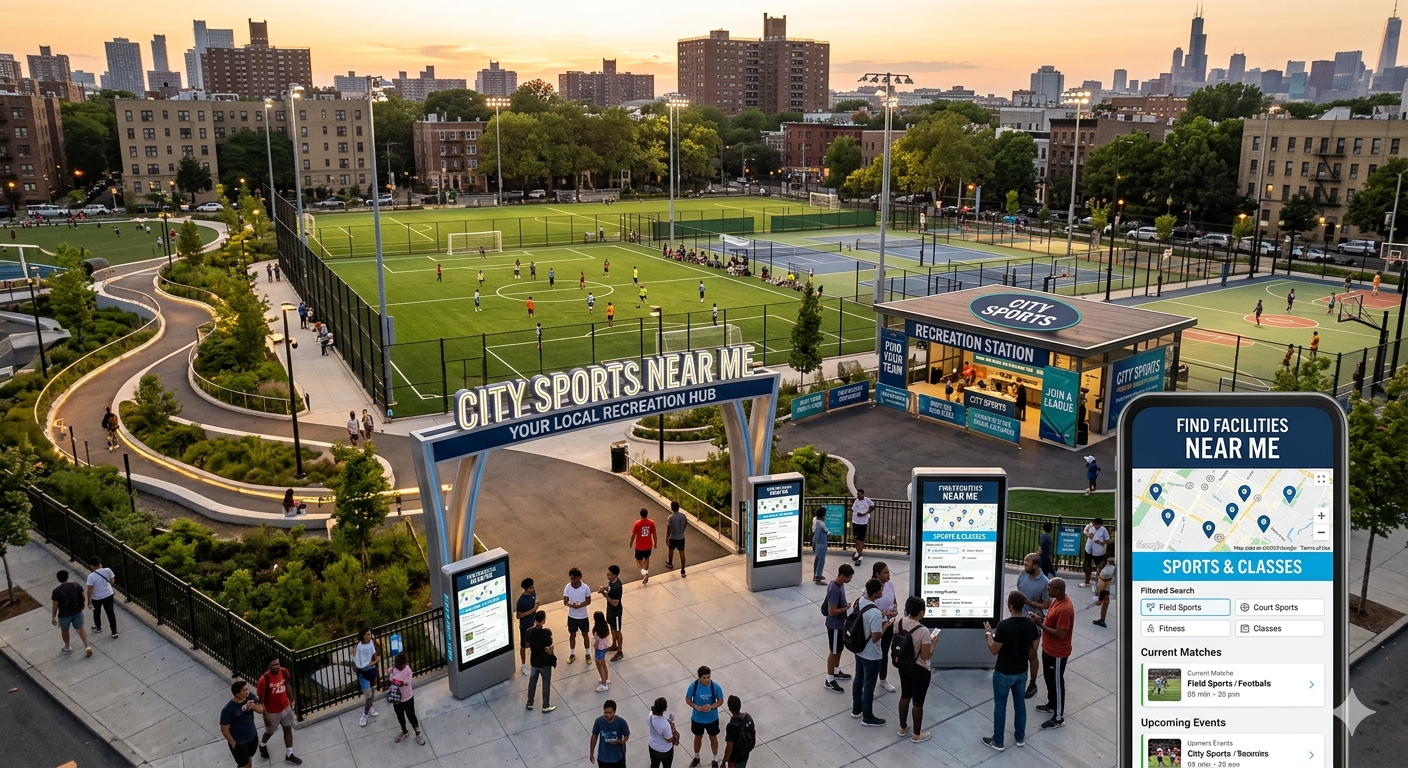
Introduction: Stop Wasting Time Searching and Start Playing
If you’ve ever typed “city sports near me” into a search bar at 7 p.m. on a Tuesday, you already know the frustration — dozens of results, half of them outdated, none of them actually telling you where to show up. This guide fixes that.
Whether you’re new to a neighborhood or just finally motivated to get off the couch, finding accessible local sports shouldn’t be a part-time job. According to the Physical Activity Council’s 2023 Participation Report, over 27% of Americans say the top barrier to playing sports is simply not knowing where to go. That gap is exactly what this guide addresses.
What Counts as “City Sports”?
Before diving into how to find them, it helps to understand the landscape. City sports aren’t just pickup basketball — the category is much broader than most people assume.
City sports typically include:
- Recreational leagues — organized seasonal play in soccer, softball, volleyball, flag football, and more
- Drop-in pickup games — informal, unscheduled games at public courts or fields
- Municipal fitness programs — city-run classes, swim lessons, and yoga offered through parks and recreation departments
- Youth athletic programs — after-school and weekend leagues for players under 18
- Adult competitive leagues — skills-based divisions in sports like tennis, basketball, and hockey
- Community fitness events — charity runs, cycling tours, and outdoor boot camps
Knowing which category you’re interested in narrows your search significantly and gets you on a field faster.
H2: How to Find City Sports Near Me Without Wasting Hours Online
The most reliable starting point isn’t Google — it’s your city or county’s official Parks and Recreation website. These portals list every sanctioned program, court reservation system, and seasonal league registration date.
Check Your Local Parks and Recreation Department First
Most municipalities update their rec portals seasonally, and many now include real-time court availability. Search “[your city name] parks and recreation” and look for a “programs” or “sports” tab. Registration fees for city leagues typically run $30–$120 per season, far below private club rates.
Use Dedicated Sports-Finding Apps and Platforms
Several platforms exist specifically to connect players with local games:
- Meetup.com — Strong for adult recreational sports groups by neighborhood
- PlayMetrics — Used by youth leagues and club organizations
- Sportsvite — Lets you create or join local pickup games by sport and skill level
- YSN (Your Sports Network) — Popular for youth travel and rec leagues
- Facebook Groups — Often the most active hubs for neighborhood pickup sports
Each platform has different strengths, so check two or three rather than relying on just one. The best options for city sports near me situations tend to combine a parks department search with one app.
Ask at Local Gyms and Community Centers
Front desk staff at Planet Fitness, YMCA branches, and independent gyms often know about local leagues that never show up online. The YMCA alone operates over 2,700 locations in the U.S., many of which run their own basketball, pickleball, and swim programs open to non-members for a drop-in fee.
H2: The Most Popular City Sports Near Me — and Where to Play Them
Different sports have different access points. Here’s a practical breakdown of the most common ones and how to find them locally.
Basketball
Public outdoor courts are the easiest entry point. Google Maps “basketball courts near me” and filter by “open now.” For indoor leagues, your city rec department and YMCA are your best bets. NBA reports that over 26 million Americans play basketball recreationally — meaning courts in most mid-size cities see active pickup games on weekday evenings.
Soccer
Soccer fields are widely available through public parks, but organized play often requires joining a league. Organizations like the Adult Soccer Association (ASA) operate city-level leagues in hundreds of metros. Many immigrant communities also run informal weekend leagues in local parks — worth asking around locally.
Pickleball
Pickleball is the fastest-growing sport in America, with a 158.6% participation surge over three years according to the Sports & Fitness Industry Association. Most cities have converted tennis courts or added dedicated pickleball courts. Search USA Pickleball’s court locator at places.usapickleball.org for the most accurate listings.
Tennis
Public tennis courts are available in nearly every city park system. For organized play, the USTA (United States Tennis Association) runs a national league program called USTA League that places you in a division by skill level. Registration opens seasonally and is searchable by zip code on usta.com.
Flag Football
NFL FLAG operates organized leagues for both youth and adults in most major metro areas. Adult leagues typically run in spring and fall, with teams forming through the NFL FLAG website or local recreation centers. Average season fees run around $60–$90 per player.
Running Clubs
Free running clubs are among the most overlooked city sports resources. Fleet Feet, Running Room, and local independent running stores host weekly group runs — no registration, no fee, just show up. These often evolve into informal racing teams and social communities.
H2: City Sports Near Me for Families and Kids
Finding youth sports in your city requires a slightly different approach, since most programs run through schools, parks departments, or private leagues — and deadlines matter more.
Youth Recreation Leagues vs. Travel Leagues
Recreation leagues prioritize inclusion and are open to most kids regardless of skill level. Travel leagues are competitive, involve tryouts, and require more time and money. For most families exploring city sports near me for the first time, rec leagues are the right starting point.
What to look for in a youth program:
- Age-appropriate divisions (not just one big group)
- Certified or background-checked coaches
- Clear communication about schedule and fees upfront
- Safety protocols and emergency contact policies
The National Recreation and Park Association (NRPA) reports that 90% of Americans live within a 10-minute walk of a park — but far fewer know which sports programs operate out of those parks. That’s why calling your local rec department directly often surfaces options that don’t appear online.
H2: Cost Breakdown — What to Expect When Joining City Sports
Cost is one of the first questions people have, and it varies significantly by sport, city size, and whether the program is public or private.
| Program Type | Typical Seasonal Cost |
|---|---|
| City rec league (adult) | $30 – $120 |
| YMCA sports programs | $40 – $150 (membership may apply) |
| Private adult league | $100 – $300 |
| Youth travel league | $500 – $2,500+ per season |
| Drop-in pickup games | Free – $10 per session |
| Public court use | Usually free |
Financial assistance is more available than most people realize. Many parks departments offer fee waivers or sliding-scale pricing. Always ask — a phone call to your rec center can save you significant money without sacrificing program quality.
Tips for Getting the Most Out of Local Sports
Finding the league or court is step one. Showing up consistently and enjoying the experience is step two. A few practical habits make a big difference.
- Arrive early for pickup games. Most informal games operate on a “winner stays” or “next team up” system. Getting there early lets you organize a team before play starts.
- Bring your own water and gear. Public courts and fields rarely provide equipment. Check the league’s website for gear requirements before your first game.
- Introduce yourself. Recreational sports communities reward regulars. A quick introduction to a few players your first week pays dividends in future game invites and team formation.
- Track the season calendar. Most city leagues have registration windows that close well before the season starts — often 4–8 weeks in advance. Missing the window means waiting a full season.
- Leave honest reviews. If you find a great league or court through an app, leaving a review helps other people searching for city sports near me find it faster.
FAQ: City Sports Near Me
1. How do I find free city sports near me?
Start with your city’s Parks and Recreation website for no-cost or low-cost public programs. Public courts for basketball, tennis, and pickleball are almost always free. Running clubs hosted by local running stores are also free. Community centers sometimes offer free trial days for leagues. Searching “free pickup [sport] near me” on Facebook Groups often surfaces informal games that cost nothing to join.
2. What’s the easiest city sport to join as a beginner?
Recreational volleyball and kickball leagues are widely considered the most beginner-friendly city sports. They require little prior experience, equipment costs are minimal, and most rec leagues divide players by skill level. Running clubs are another strong option — most welcome all paces and provide structured routes with no competitive pressure.
3. How do I find city sports near me for adults over 40?
Search specifically for “masters” or “senior” divisions in tennis (USTA), soccer, and softball. The National Senior Games Association also sponsors local qualifying events across dozens of sports. Many YMCA branches run age-grouped fitness leagues as well. Adult recreational leagues often skew older than people expect — don’t assume a general adult league will be too young.
4. Are there city sports near me that I can join mid-season?
It depends on the sport and league structure. Drop-in pickup games (basketball, soccer, pickleball) accept players anytime. Some recreational leagues allow mid-season roster additions, especially if a team has players drop out. Contact the league coordinator directly and ask — many are more flexible than their websites suggest, particularly in the first two to three weeks of a season.
5. What if I can’t find city sports near me in a specific sport?
Consider starting something yourself. Meetup.com lets you create a group in minutes, and a basic post on Nextdoor or a neighborhood Facebook group often surfaces more interested players than you’d expect. Local parks with open fields or courts are the only venue you need for pickup play. Several organized city leagues started exactly this way — with one person and a social media post.
Conclusion: Your Next Game Is Closer Than You Think
The biggest obstacle between most people and their next game isn’t motivation — it’s information. Once you know where to look, city sports near me stops being a frustrating search and becomes a five-minute task.
Start with your Parks and Recreation department, cross-reference with one sports app, and don’t underestimate the value of simply asking at a local gym or community center. Whether you want competitive league play, casual weekend pickup, or a free running group, the options in most cities are genuinely extensive.
Ready to play? Visit your city’s parks department website today, pick one sport, and sign up for the next available session. The field is waiting — and so is your team.
Introduction
When it comes to elite youth soccer in the northeastern United States, World Class FC stands in a category of its own. Founded in 2007 in Rockland County, New York, this club has built one of the most respected development programs in the region — turning raw talent into college-ready and professional-level players. Whether you’re a parent researching youth soccer options or a player looking for the right competitive environment, understanding what makes World Class FC exceptional is a smart first step.
The club operates as a non-profit organization with a clear mission: create a challenging, supportive environment where players grow both as athletes and as people. From its humble beginnings with a single team, it now fields over 100 teams and serves approximately 1,500 players across age groups ranging from U5 to U19.
History and Origins of World Class FC
World Class FC was founded in 2007 by Joseph Cipriano, who continues to serve as the club’s Director of Coaching. Starting with just one team, the club grew rapidly thanks to a philosophy that prioritized genuine player development over short-term results. That long-term approach paid off quickly — within a few seasons, the club was competing at the highest regional levels.
The club is based in Rockland County, New York, an area that serves as a geographic gateway between New York City’s talent pool and the competitive tristate soccer landscape. This positioning has helped World Class FC attract players from across the region and compete against the best clubs in the Northeast.
Key milestones in the club’s growth include:
- Founded in 2007 with one team under Director of Coaching Joseph Cipriano
- Expanded to over 100 teams within roughly a decade
- Gained membership in the Eastern New York Youth Soccer Association (ENYYSA)
- Entered prestigious competitions including the NYCSL, EDP, and ECNL circuits
- Formed a strategic partnership with New York City FC for a Girls Youth Academy in 2019
World Class FC’s Facilities and Training Environment
The club’s flagship training ground is the World Class Soccer Complex in Rockland County, which features seven dedicated soccer fields. For a youth club, having access to a purpose-built, multi-field complex is a significant competitive advantage. It allows multiple age groups to train simultaneously under structured supervision.
Beyond the main complex, the club has access to additional top-tier facilities across the Rockland County area. These spaces are equipped to support technical drills, tactical sessions, and physical conditioning — the three pillars of any serious development program.
Training quality at the facility level matters enormously in youth soccer development. According to U.S. Soccer Foundation research, access to quality facilities increases youth player retention and long-term development outcomes by a measurable margin. World Class FC has made facility investment a priority since its founding.
Leagues and Competitions: Where World Class FC Competes
Competitive exposure is a cornerstone of World Class FC’s development model. The club doesn’t just train — it tests players against the best competition available at each age level.
The club participates in the following leagues and competitions:
- New York Club Soccer League (NYCSL): A high-level regional league where World Class FC has won multiple championships, including six boys division titles in a single NY Cup Finals weekend.
- Eastern Development Program (EDP): A competitive circuit designed to bridge club soccer with college and elite pathway opportunities.
- Eastern New York Youth Soccer Association (ENYYSA): The governing body for youth soccer in the region.
- Elite Clubs National League (ECNL): One of the most prestigious youth soccer leagues in the United States, giving World Class FC players national-level competition exposure.
- U.S. Soccer Development Academy: The club competed in USSDA events, including the U-13/14 National Showcase held at Grand Park Sports Campus in Westfield, Indiana.
Participation in the ECNL alone is a strong signal of a club’s commitment to elite development. The ECNL, founded in 2009 as a girls’ league and expanded to boys in 2017, includes 128 girls’ clubs and 151 boys’ clubs nationally, making selection into this ecosystem highly competitive.
Player Development Philosophy at World Class FC
What separates World Class FC from thousands of other youth clubs across the country is its structured, long-term development philosophy. The club doesn’t chase tournament wins at the expense of individual growth — instead, it builds players from the ground up, layer by layer.
Technical and tactical instruction is backed by a coaching staff holding licenses from national and international organizations. Coaches at this level don’t just run drills; they create structured lesson plans, give individual feedback, and monitor player progress over seasons, not just games.
The club also emphasizes mental and character development alongside on-field skills. This holistic approach is increasingly recognized by college coaches and professional academies as a critical differentiator when evaluating prospects.
Notable Players Who Came Through World Class FC
One of the clearest ways to judge a youth development program is by examining where its players end up. World Class FC has an impressive track record of producing talent that succeeds at the next level.
Notable alumni include:
- Brenden Aaronson — Developed through World Class FC before advancing to the Philadelphia Union’s MLS first team and earning caps with the United States Men’s National Team. He later moved to European football, representing the high ceiling the club’s pathway can reach.
- Sean Nealis — Played for Hofstra University after leaving the club, then signed a professional contract with the New York Red Bulls in MLS, becoming a regular in their defensive setup.
- Christina Klaum — Went on to play for Columbia University, where she was named the Ivy League Rookie of the Year — a prestigious academic-athletic honor.
These are not outliers. World Class FC consistently sends players to NCAA Division I programs and semi-professional leagues. The pipeline is real, documented, and growing.
World Class FC and the NYCFC Partnership
In 2019, World Class FC made a landmark announcement that elevated the club’s profile significantly. The club partnered with New York City FC — the Major League Soccer franchise backed by the City Football Group — to launch the NYCFC/World Class FC Girls Youth Academy.
This partnership gave the Girls Academy access to NYCFC’s professional infrastructure, coaching methodology, and brand recognition. The partnership covered four competitive age groups: U-14, U-15, U-16/17, and U-18/19, providing girls players in the New York metro area with a professional development environment rarely seen outside of full-time academies.
This type of MLS-youth club collaboration is increasingly common across American soccer, but securing it reflects the trust major professional organizations place in World Class FC’s operational and development standards.
How World Class FC Supports the College Recruiting Process
For many families, the ultimate goal of investing in elite youth soccer is earning a college scholarship or playing collegiately. World Class FC understands this and actively supports the recruiting journey for its players.
Competing in high-visibility leagues like the ECNL and EDP ensures players are seen by college scouts at regional and national showcase events. Many of the tournaments the club participates in are specifically designed to maximize college coach attendance.
Additionally, players who develop measurable technical skills and game intelligence through the club’s structured program arrive at recruiting showcases ready to perform, not just participate. The difference between a player who has gone through a rigorous development program and one who hasn’t is immediately visible to experienced college coaches.
Recreational and Competitive Programs for All Ages
One of the things families appreciate most about World Class FC is that it caters to a wide range of player ambitions. The club isn’t exclusively for elite-track players.
- Recreational programs begin as early as U5, introducing children to the game in a fun, low-pressure environment.
- Competitive programs scale up progressively, with tryouts and merit-based team selection becoming more rigorous at older age groups.
- Elite pathways are available for top performers, including ECNL-level teams and the NYCFC partnership program for girls.
This tiered structure means a player who falls in love with the game at age five can grow through the same club ecosystem all the way to age 19, developing at whatever pace and ambition level suits them. Few youth organizations manage this breadth without sacrificing depth at either end.
FAQ: World Class FC
Where is World Class FC located?
World Class FC is based in Rockland County, New York. Its main training and match venue is the World Class Soccer Complex, a seven-field facility in the region. The club also uses additional facilities across the county to accommodate its large roster of over 100 teams.
When was World Class FC founded?
The club was founded in 2007 by Joseph Cipriano, who remains involved as Director of Coaching. It started with a single team and has expanded over nearly two decades into one of the largest and most respected youth soccer programs in the New York area.
What leagues does World Class FC compete in?
World Class FC participates in the New York Club Soccer League (NYCSL), the Eastern Development Program (EDP), the Eastern New York Youth Soccer Association (ENYYSA), and the Elite Clubs National League (ECNL). The club has also competed in U.S. Soccer Development Academy showcase events at the national level.
Has World Class FC produced any professional players?
Yes. The most prominent alumni include Brenden Aaronson, who went on to play in MLS for the Philadelphia Union and represented the U.S. Men’s National Team, and Sean Nealis, who signed with the New York Red Bulls in MLS. Several other alumni have gone on to compete in NCAA Division I programs and lower-level professional leagues.
How do I register or try out for World Class FC?
Tryouts are typically held at the end of the spring season for the following fall. Interested players should visit the club’s official website or contact the Eastern New York Youth Soccer Association for current registration and tryout information. Age group requirements and team availability vary season to season.
Conclusion
World Class FC is not a typical youth soccer club. Built on a foundation of serious player development, professional facilities, high-level competitive exposure, and a coaching staff that invests in individual growth, it has earned its status as one of New York’s premier soccer organizations. The club’s alumni list, competitive results, and institutional partnerships — including with NYCFC — speak for themselves.
If you’re a player or parent exploring development pathways in the northeastern United States, World Class FC deserves serious consideration. Visit the club’s official website, attend an information session, and talk to current families in the program. The best way to understand what this club offers is to experience it firsthand — and the players who have come before you already know what’s possible when the environment is right.
If you follow competitive football gaming, you have seen the FIFAe logo dozens of times — on broadcast overlays, tournament stages, and esports merchandise. But most people have never stopped to understand what this mark actually communicates, how it was built, or why it looks the way it does. This guide covers every angle of the FIFAe logo with the depth it deserves, from its foundational design principles to its practical use cases in esports branding.
What Is FIFAe and Why Does Its Logo Matter?
FIFAe is FIFA’s official competitive esports platform, serving as the governing hub for all sanctioned football gaming competitions worldwide. It manages three flagship competitions: the FIFA Global Series, the FIFAe Club Series, and the FIFAe Nations Series.
The FIFAe logo is not a decorative afterthought. It is the primary visual anchor that connects all of these competitions under a single recognizable identity. FIFAe (fifa.gg) functions as the official competitive esports platform and information hub for FIFA video game competitive play, providing schedules, results, team and player information, and coverage for tournaments across the FIFA Global Series, FIFAe Club Series, and FIFAe Nations Series.
For esports organizations, tournament organizers, and fans, the logo signals official status and competitive legitimacy. Without a strong visual identity, a competitive platform risks blending into a crowded digital landscape.
According to global esports industry reports, the football gaming segment attracts hundreds of millions of casual and competitive players annually — making recognizable branding like the FIFAe logo commercially critical, not optional.
The Origins of the FIFAe Logo
From FIFA to FIFAe: A Brand Split
Understanding the FIFAe logo requires understanding its parent brand. The current FIFA logo is a wordmark created in 1998 that became official in 2009, and its bold blue lettering with diagonal cuts on the “F” characters is now instantly recognizable across the globe.
When FIFA decided to carve out a dedicated esports identity, it needed a mark that would feel both familiar and distinctly digital. The result was FIFAe — a sub-brand carrying the weight of FIFA’s authority while signaling something newer, faster, and more interactive.
The FIFAe branding emerged around 2020, aligning with the rapid growth of organized football esports. Rather than using the FIFA corporate logo outright, the organization built a separate visual identity for the competitive gaming ecosystem.
This kind of masterbrand architecture — where a parent brand’s equity feeds a sub-brand — is a proven strategy in sports marketing. The FIFAe logo inherits trust from FIFA while carving out its own visual space.
FIFAe Logo Design Elements Explained
Typography and Wordmark Structure
The FIFAe logo is primarily a wordmark — meaning the logotype itself carries the identity rather than an abstract symbol. The “FIFA” portion of the mark leans heavily on the established corporate typeface: a custom bold sans-serif with diagonal cuts on the “F” characters designed for maximum legibility at small scales.
The lowercase “e” appended to “FIFA” is the design move that sets FIFAe apart. It visually communicates:
- A digital or electronic sub-category
- A shift toward interactivity and gaming
- A younger, more informal tone compared to the parent institution
This single typographic choice carries enormous brand meaning. In logo design, suffixes and letterform modifications are often more powerful communicators than full rebrands.
Color Palette
The FIFAe logo draws directly from FIFA’s established color language. The “FIFA” wordmark uses FIFA Blue, and according to general color psychology principles, blue represents trust, intelligence, and authority.
For the esports context, this blue palette serves a dual purpose:
- Credibility transfer — The same color audiences associate with official FIFA authority now applies to competitive gaming
- Digital legibility — Deep blue reads cleanly on broadcast screens, streaming overlays, and dark-mode tournament interfaces
White is used as the primary contrast color, creating a clean, confident presentation. Some FIFAe applications also incorporate black backgrounds, particularly in esports broadcast contexts where dark environments dominate.
How the FIFAe Logo Functions Across Different Platforms
Broadcast and Streaming
Esports events are primarily consumed through screens — Twitch, YouTube, and official broadcast partners. The FIFAe logo is designed to hold up at thumbnail size and at full broadcast resolution equally well.
One of FIFA’s deliberate branding goals with its wordmark was to modernize the identity and create a clean, adaptable logo for digital platforms, HDTV broadcasts, and global merchandising. The FIFAe mark inherits this same logic.
A wordmark-only logo is especially effective in esports because:
- It reads clearly when overlaid on gameplay footage
- It scales down to icons and social media avatars without losing legibility
- It does not compete visually with in-game imagery
Merchandise and Physical Applications
FIFAe merchandise is crafted for fans who love competition both on the pitch and online. On apparel, the logo is typically rendered in white on dark backgrounds, or in FIFA Blue on white — both delivering the same strong contrast.
Physical merchandise tests a logo in ways digital applications do not: stitching, embossing, and screen printing all reveal weaknesses in complex designs. The FIFAe logo, with its clean letterforms, handles these production methods without distortion.
FIFAe Logo vs. FIFA Corporate Logo: Key Differences
Many people assume the FIFAe logo is simply the FIFA logo with “e” added. The distinction runs deeper than that.
Here is a direct comparison:
| Feature | FIFA Logo | FIFAe Logo |
|---|---|---|
| Purpose | Governing body identity | Esports platform identity |
| Tone | Institutional, authoritative | Dynamic, digital-forward |
| Audience | Broad global football audience | Competitive gaming community |
| Primary format | Globe emblem + wordmark | Esports-adapted wordmark |
| Context | Official federation communications | Tournaments, streams, gaming content |
The FIFA logo features two hemispheres to symbolize the organization’s round-the-world presence, with the globes depicting continents and featuring a white pentagonal soccer ball pattern. The FIFAe logo strips away this imagery, prioritizing a cleaner mark suited to the speed of digital consumption.
This is not a downgrade — it is a deliberate simplification that serves a different communication environment.
The FIFAe Logo in Competitive Esports Branding
Sub-Brand Logo Architecture
The FIFAe Nations Series debuted in 2019 and brought together elite gamers representing their countries in a 2-on-2 format, blending national pride with digital football competition on the global stage. Each of these tournament series carries its own visual identity — but all of them sit beneath the FIFAe umbrella mark.
This creates a logo ecosystem where:
- The FIFAe logo acts as the authority mark
- Tournament sub-logos (FIFAe Nations Series, FIFAe Club Series) carry event-specific personality
- Together, they form a recognizable visual family
Strong sub-brand architecture is rare in esports. Most organizations struggle with visual consistency across properties. FIFAe’s approach — anchoring everything to a clear parent mark — is worth studying for anyone building competitive gaming brands.
How It Compares to Other Esports Logos
The broader esports industry offers instructive comparisons. Successful esports logos like Fnatic’s mark demonstrate how a simplified, abstract logo using sharp points and curves, rendered in distinctive colors, can build a powerful brand identity over time.
FIFAe takes a different approach — prioritizing institutional trust over edge aesthetics. Where Fnatic or similar organizations lean into aggressive visual styles aimed at hardcore gaming culture, FIFAe serves a broader audience that includes football fans who may be new to esports.
This is a strategic branding decision, not a design limitation.
Where to Find and Download the FIFAe Logo Legally
If you are a tournament organizer, journalist, or content creator who needs the FIFAe logo, there are proper channels to access it.
Official sources for the FIFAe logo:
- FIFA’s official media resources page at fifa.com — FIFA maintains a press and media section with approved brand assets for editorial use
- Logokit.com — Logokit hosts high-quality SVG, PNG, and vector versions of the FIFAe logo for identification purposes, though it is not affiliated with FIFA
- Logos-download.com — Hosts the FIFAe Nations Series logo in SVG and PNG formats for editorial reference
What you should never do:
- Modify the logo colors or proportions without FIFA’s permission
- Use the FIFAe logo to imply official partnership or endorsement
- Place the logo on commercial products without a licensing agreement
- Create derivative marks that incorporate FIFA or FIFAe branding
FIFA is aggressive about brand protection. Using the logo improperly — even for fan content — can trigger intellectual property disputes. When in doubt, seek written permission through FIFA’s official licensing channels.
What Makes the FIFAe Logo Effective Branding
Good logos solve specific problems. The FIFAe logo solves several simultaneously:
- Instant recognition — The FIFA wordmark is one of the most recognized marks on the planet. FIFAe piggybacks on that equity immediately
- Clear sub-brand signaling — The “e” suffix clearly communicates the electronic/esports context without explanation
- Versatility — The wordmark format works across screens, merchandise, signage, and digital overlays
- Scalability — From a 16x16px favicon to a stadium-sized LED display, the mark holds its visual integrity
- Audience bridging — Football fans and gaming fans can both immediately parse what FIFAe represents
FIFA’s management of its visual identity — even through institutional challenges — proves that a strong, consistent brand architecture can survive almost anything. The FIFAe logo extends this brand resilience into new competitive territory.
Common Mistakes When Using the FIFAe Logo
Designers and content creators frequently make errors when working with the FIFAe logo. Avoid these:
- Stretching or distorting the wordmark — Always maintain the original proportions
- Using low-resolution versions — Always source SVG or high-DPI PNG files
- Placing the logo on busy backgrounds — Ensure sufficient contrast so the mark remains legible
- Adding drop shadows or effects — Official brand guidelines prohibit unauthorized modifications
- Using outdated versions — FIFA periodically refreshes brand assets; always verify you have the current mark
These guidelines apply to any serious brand, but FIFA enforces them more rigorously than most organizations given its global commercial scale.
FAQ: FIFAe Logo
What does the “e” in the FIFAe logo stand for? The “e” in FIFAe stands for “esports.” FIFA introduced the FIFAe sub-brand to separate its competitive gaming platform from the broader football governing body. The suffix is a deliberate typographic signal that positions the brand within the esports ecosystem while maintaining the authority of the FIFA parent brand.
Can I use the FIFAe logo for my esports tournament? Not without explicit permission from FIFA. The FIFAe logo is protected intellectual property. Unauthorized commercial use — including on tournament materials, merchandise, or promotional graphics — can result in legal action. If you are organizing an officially sanctioned FIFAe event, FIFA will provide approved brand assets through your partnership agreement.
What colors are used in the FIFAe logo? The FIFAe logo primarily uses FIFA Blue and white. FIFA Blue is a deep, authoritative shade that communicates trust and institutional credibility. In esports contexts, the logo is often displayed on black or dark backgrounds for maximum contrast and broadcast visibility.
Where can I download the official FIFAe logo in SVG format? FIFA provides official brand assets through its media resources section at fifa.com for press and editorial use. Third-party logo repositories like Logokit also host SVG versions, though these are for identification purposes only and not for commercial use without FIFA’s authorization.
Is the FIFAe logo different from the FIFA logo? Yes. The FIFA corporate logo features two overlapping globes above the bold wordmark, representing global unity. The FIFAe logo is a streamlined wordmark that drops the globe emblem and incorporates the “e” suffix, creating a visually distinct mark suited to digital and esports environments while still drawing on FIFA’s established visual language.
Conclusion
The FIFAe logo is more than a wordmark — it is a carefully constructed piece of brand architecture that bridges football’s century-long institutional authority with the fast-moving world of competitive gaming. Every design decision, from the typeface to the color palette to the lowercase “e,” carries deliberate meaning and serves a specific strategic purpose.
Whether you are a designer studying esports branding, a content creator needing to reference the mark, or a tournament organizer working within the FIFAe ecosystem, understanding the FIFAe logo at this level of depth helps you use and respect it correctly.
Ready to go further? Visit fifa.gg for the official FIFAe platform and explore their current tournament schedule — and if you are building an esports brand of your own, use the FIFAe logo as a benchmark for what disciplined, scalable visual identity design looks like.
Sichere KYC-Verifizierung bei Goldbet Casino: So schützen Sie Ihre Daten
Maximize your fun: What to know about Neosurf Casino Australia 2026’s game features
How to maximize your experience at New Online Casino Canada 2026: A guide for

FIFA Login: Complete Guide to Access Your FIFA Account Securely

The Ultimate Guide to Adventureppctop.com Business License: Transparency and Compliance in Digital Advertising

Contact DesignMode24 Com: Features and Support Guide
-
 FIFA world Cup4 months ago
FIFA Login: Complete Guide to Access Your FIFA Account Securely
-
Business6 months ago
The Ultimate Guide to Adventureppctop.com Business License: Transparency and Compliance in Digital Advertising
-
 Blog4 months ago
Contact DesignMode24 Com: Features and Support Guide
-
 Gadgets7 months ago
The Ultimate Guide to the Best Linux Distro for Gaming in 2026
-

 FIFA world Cup4 months ago
City Sports Near Me: The Complete Guide to Finding Local Athletic Activities
-
 FIFA world Cup5 months ago
Ticketing Software Features for World Cup 2026 Openers
-

 Blog5 months ago
Beyond the Buttons: under growth games uggcontroman controller Controller Philosophy
-
 Sports7 months ago
Devoropa Sports: The Ultimate Guide to High-Performance Athletic Gear