
The Great Wall of 2013: Analyzing the Best Defenders in FIFA 13
If you close your eyes and think back to the autumn of 2012, you can almost hear the soundtrack of Imagine Dragons playing in the background while you navigate the yellow-and-black menus of FIFA 13. It was a transitional era for EA Sports. Tactical Defending had been introduced just a year prior, and players were finally mastering the art of jockeying and timed tackling.
- The Gold Standard: Top-Rated Center-Backs
- 1. Nemanja Vidic (Manchester United) – 89 OVR
- 2. Thiago Silva (PSG) – 87 OVR
- 3. Vincent Kompany (Manchester City) – 86 OVR
- Reed Article
- The Masters of the Flanks: Top Full-Backs
- Career Mode Gems: Building for the Future
- The Art of Defending in FIFA 13: Tactics and Mechanics
- The Importance of “Strength” and “Aggression”
- The Near-Post Corner Glitch
- Work Rates: The Hidden Killer
- Comparison: FIFA 13 vs. The Modern Era (FC 25/26)
- Frequently Asked Questions (FAQs)
- Who was the fastest center-back in FIFA 13?
- Why was Dede so expensive in FIFA 13 Ultimate Team?
- Did FIFA 13 have Legends or Icons?
- Who was the best budget defender in the Premier League?
- How do I stop the “Lobby Through Ball” in FIFA 13?
- Final Thoughts
In FIFA 13, the defensive line wasn’t just a barrier; it was the foundation of every winning Ultimate Team (FUT) and Career Mode squad. Whether you were trying to stop a peak Lionel Messi or a sweat-heavy front line of Welliton and Emmanuel Emenike, your choice of defenders determined your blood pressure for the next twelve minutes.
Let’s dive deep into the vault and analyze the top defenders who defined an era of virtual football.
The Gold Standard: Top-Rated Center-Backs
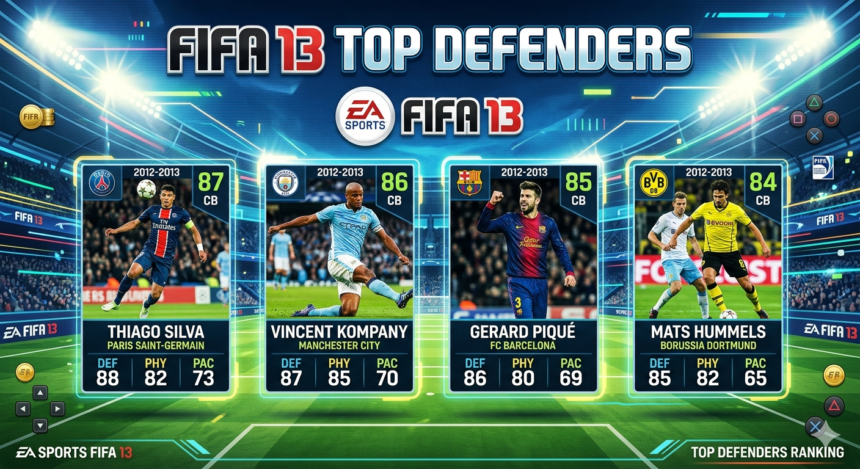
When looking at the raw data, FIFA 13 featured a collection of legendary names who were at the absolute peak of their real-world powers. These were the “blue chip” investments for any Ultimate Team player.
1. Nemanja Vidic (Manchester United) – 89 OVR
The highest-rated defender in the game was the Serbian powerhouse from Manchester United. Vidic was the personification of “The Wall.” With an incredible 92 Defending and 92 Strength, he was almost impossible to beat in a 1-on-1 physical duel. However, Vidic also represented the struggle of the “Old Guard” in FIFA 13. With a pace rating in the 50s, he was a liability if you played a high defensive line. If an opponent got behind him, it was game over.
2. Thiago Silva (PSG) – 87 OVR
If Vidic was the muscle, Thiago Silva was the Ferrari. Many veteran players consider FIFA 13 Thiago Silva to be one of the greatest center-backs in the history of the franchise. After his high-profile move to PSG, his card became the cornerstone of Brazilian “sweat” squads.
-
Pace: 82 (Elite for a CB)
-
Defending: 87
-
Jumping: 90 He could outrun strikers, out-jump giants, and his recovery tackles were legendary. He was the most expensive non-inform gold CB for a reason.
3. Vincent Kompany (Manchester City) – 86 OVR
The captain of the reigning Premier League champions was a “must-have” for any EPL-based squad. Kompany was remarkably balanced. He felt faster than his 73 pace suggested, and his 89 Strength made him a nightmare for attackers. His “High” defensive work rate meant he was always in the right position to intercept a stray through-ball.
Reed Article
https://fifaworld.co.uk/the-role-of-ai-and-data-analytics-in-modern-coaching/
https://fifaworld.co.uk/petir108win-online-2/
https://fifaworld.co.uk/how-to-apply-for-fifa-world-cup-2026-tickets/
The “OP” Legends: When Ratings Didn’t Matter
In FIFA 13, the “Overall” rating was often a lie. A sub-culture emerged in the community focusing on “Overpowered” (OP) players—cards with specific stat distributions that made them perform far above their pay grade.
The Brazilian Wall: Dede and Felipe Santana
If you played Ultimate Team in 2013, you probably still have nightmares about the silver-and-gold Brazilian links.
-
Dede (81 OVR): Don’t let the 81 fool you. Dede had 81 Pace and 84 Strength. He was a vacuum cleaner for the ball. In the FIFA 13 meta, he was arguably more effective than a 90-rated Gerard Piqué.
-
Felipe Santana (77 OVR): Playing for Borussia Dortmund at the time, Santana had 81 Pace and was 6’4″. He was the ultimate counter to the “cross-and-head” meta. He could catch Cristiano Ronaldo in a sprint and then tower over him in the air.
The Italian Stallion: Angelo Ogbonna (79 OVR)
Ogbonna was the definition of a “budget beast.” With 80 Pace and 85 Strength, he was the anchor of many Serie A squads. Because he played for Torino, he was cheap to acquire but provided the same defensive security as Giorgio Chiellini (who was also elite but significantly more expensive).
The Masters of the Flanks: Top Full-Backs
The role of the full-back in FIFA 13 was dual-purpose. You needed them to stay back and stop pacy wingers, but the game mechanics also rewarded overlapping runs and high-volume crossing.
Dani Alves (Barcelona) – 84 OVR
Alves was essentially a right-winger playing at RB. With 90 Pace and incredible dribbling stats, he was the offensive engine of La Liga teams. While his “High/Low” work rates often left him out of position defensively, his recovery speed usually allowed him to get back in time.
Philipp Lahm (Bayern Munich) – 87 OVR
Lahm was the technician. He wasn’t the fastest (77 Pace), but his tackling was the cleanest in the game. If you preferred a “Possession” style of play, Lahm was your man. He rarely missed a pass and almost never committed a foul when using the standing tackle button.
Ashley Cole (Chelsea) – 84 OVR
At LB, Ashley Cole was the gold standard for the Premier League. He was remarkably consistent. With 82 Pace and 84 Defending, he was one of the few players who could consistently shut down the likes of Theo Walcott or Aaron Lennon.
Career Mode Gems: Building for the Future
For those who preferred the long grind of Career Mode over the frantic nature of Ultimate Team, FIFA 13 offered some incredible defensive prospects. These were the players you bought on day one and watched grow into 90+ rated superstars.
-
Raphaël Varane (Real Madrid): Starting at a modest 76 OVR, Varane had a potential of 88+. His height and natural speed made him the perfect long-term replacement for any aging center-back.
-
Marquinhos (Roma): Before his move to PSG, Marquinhos was a 17-year-old wonderkid with massive growth potential. He was the go-to signing for anyone starting a “Road to Glory” save.
-
David Alaba (Bayern Munich): Initially a midfielder/left-back hybrid, Alaba’s growth in FIFA 13 was explosive. He would quickly become the best LB in the game, possessing 90+ pace and incredible free-kick stats.
The Art of Defending in FIFA 13: Tactics and Mechanics
To understand why these defenders were so good, we have to look at the game’s mechanics. FIFA 13 was the second year of Tactical Defending. Unlike the old “Legacy Defending” where you just held a button to pressure the ball, Tactical Defending required manual positioning.
The Importance of “Strength” and “Aggression”
In FIFA 13, the “jostle” mechanic was heavily influenced by the Strength stat. When two players were running side-by-side, a defender with 90 Strength (like Pepe or Vidic) could literally shove a striker off the ball. This made “Physicality” a primary meta-stat.
The Near-Post Corner Glitch
One of the frustrations of FIFA 13 was the near-post corner. If you had a defender with high Heading Accuracy and Jumping, you could negate this. This is why players like Mats Hummels (85 OVR) were highly valued despite their lack of pace—they were aerial insurance policies.
Work Rates: The Hidden Killer
FIFA 13 was the year many players started paying attention to “Work Rates.” A defender with a “High” attacking work rate and “Low” defensive work rate (like David Luiz) was often caught too far forward. The “Ideal” center-back had “Low/High” or “Medium/High” work rates, ensuring they stayed anchored to the penalty area.
Comparison: FIFA 13 vs. The Modern Era (FC 25/26)
Looking back from the perspective of 2026, it’s fascinating to see how defending has evolved. In FIFA 13, “PlayStyles” didn’t exist. You didn’t have “Anticipate+” or “Block+” traits. Defensive quality was distilled down to pure numbers and player models.
Modern games focus heavily on animations and AI intelligence. In FIFA 13, defending was more “arcade-like.” If you had the pace, you could recover from almost any mistake. Today, a defender’s positioning AI is far more complex, but there’s a certain charm to the simplicity of FIFA 13 where a 77-rated Felipe Santana could become a global icon simply because he was fast and tall.
Frequently Asked Questions (FAQs)
Who was the fastest center-back in FIFA 13?
The crown generally went to Marvel Wynne, a silver card with a staggering 96 Pace. In terms of gold cards, Dede and Thiago Silva were the speed kings at the heart of the defense.
Why was Dede so expensive in FIFA 13 Ultimate Team?
Dede was expensive because he possessed the “Holy Trinity” of FIFA 13 stats: Brazilian links, 80+ Pace, and 80+ Strength. He allowed players to build “sweat” squads that could compete with multi-million coin teams.
Did FIFA 13 have Legends or Icons?
In FIFA 13, “Legends” were exclusive to Xbox users. Players like Paolo Maldini and Fabio Cannavaro were available, but they were incredibly rare and out of reach for the average player.
Who was the best budget defender in the Premier League?
Younes Kaboul and Laurent Koscielny were the go-to budget options. They both offered high pace and solid defending stats for a fraction of the price of Vincent Kompany.
How do I stop the “Lobby Through Ball” in FIFA 13?
The best way to stop the overpowered lofted through-ball was to manually control your fastest defender and start backing off as soon as you saw the opponent’s midfielder winding up for a pass. Using defenders like Sergio Ramos helped because of his high acceleration.
Final Thoughts
The defenders of FIFA 13 were more than just digital avatars; they were the heroes of our weekend leagues and the foundations of our virtual dynasties. From the raw power of Vidic to the lightning speed of the Brazilian “OP” cards, this era of FIFA provided a unique balance of realism and arcade fun.
As we look forward to the future of football gaming in 2026 and beyond, we still look back at the FIFA 13 defensive meta as a benchmark for what made the series so addictive. Whether you were a “Tactical Defending” master or someone who relied on the raw pace of Felipe Santana, those cards will forever be etched in the history of the beautiful (digital) game.
Are you looking to recreate the magic of the 2013 era in your modern saves? Or perhaps you’re researching the history of FUT? Whatever your goal, understanding these defensive giants is the first step to mastering the pitch.