

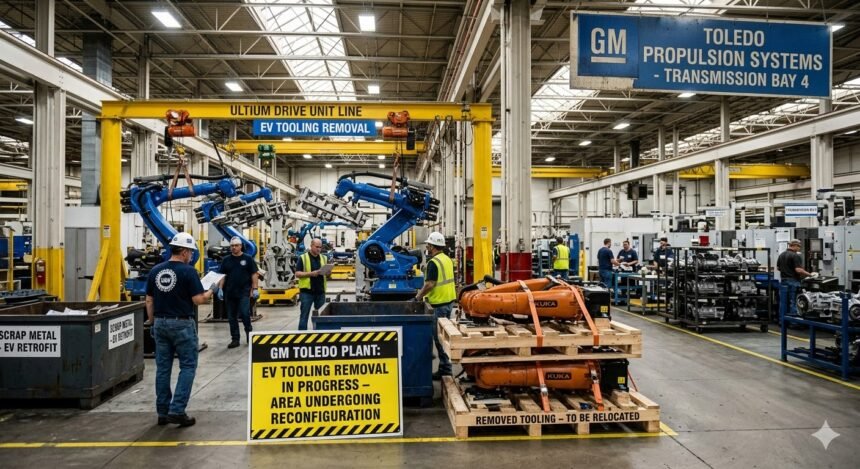
The automotive landscape is shifting once again, and nowhere is this more visible than at the Toledo Propulsion Systems facility. Recent reports regarding the GM Toledo plant EV tooling removal have sparked intense discussion among industry analysts, local workers, and automotive enthusiasts. What was once hailed as the “hub of the electric future” is now undergoing a physical transformation that mirrors a broader strategic retreat across the global manufacturing sector.
- The Strategic Shift: Why GM Toledo Plant EV Tooling Removal is Happening Now
- Financial Impact: A $6 Billion Reality Check
- From Electric Dreams to 10-Speed Transmissions
- The Broader Context: GM’s “All-Electric Future” Delayed?
- Local Economic Ripples in Toledo, Ohio
- Conclusion: Flexibility is the New Currency
- Frequently Asked Questions (FAQs)
For decades, the Toledo plant has been the heartbeat of General Motors’ transmission production. However, as the industry enters 2026, the anticipated “EV revolution” has met the cold reality of consumer hesitancy and shifting federal policies. The decision to pull back on electric drive unit (EDU) production isn’t just a local logistical change; it represents a multibillion-dollar realignment of how America builds its trucks and SUVs.
The Strategic Shift: Why GM Toledo Plant EV Tooling Removal is Happening Now
The GM Toledo plant EV tooling removal is primarily driven by a “market-first” philosophy. In late 2024 and throughout 2025, General Motors observed a significant cooling in the demand for high-end electric pickups. While the Ultium platform remains a technical marvel, the sales figures for vehicles like the Chevrolet Silverado EV and GMC Sierra EV did not meet the aggressive internal projections set years prior.
Aligning with Consumer Demand
GM leadership, including plant director Rob Morris, recently confirmed that the removal of one of the major electric drive unit lines is a direct response to current buying patterns. Consumers are currently favoring internal combustion engine (ICE) products—specifically the high-margin full-size trucks that the Toledo plant supports. By removing the underutilized EV equipment, GM is clearing the floor for a $200 million investment in additional 10-speed transmission production.
The Role of Regulatory Changes
Politics and policy have played a massive role in the Toledo Propulsion Systems transition. With the expiration of major federal EV tax credits in late 2025 and a softening of federal emissions mandates in early 2026, the financial incentives for consumers to switch to electric have dwindled. For GM, keeping millions of dollars in specialized tooling on a factory floor that isn’t producing units is a “waste of floor space,” according to UAW Local 14 leaders.
Financial Impact: A $6 Billion Reality Check
The GM Toledo plant EV tooling removal is part of a massive corporate write-down. In early 2026, General Motors disclosed a $6 billion special charge related to the scaling back of its EV ambitions.
-
Contract Cancellations: A large portion of these charges comes from canceling agreements with suppliers who were slated to provide components for the Toledo-built drive units.
-
Asset Impairment: The specialized robotic arms, precision cooling systems, and assembly jigs used for EV propulsion systems lose significant value when they are decommissioned or sold for parts.
-
Subsidies and Credits: As the company pivots back to V8 engines and 10-speed transmissions, it must navigate a world where carbon credits are no longer the primary driver of the bottom line.
From Electric Dreams to 10-Speed Transmissions
The $760 million investment initially announced in 2022 was supposed to make Toledo the first U.S. powertrain facility to produce EV drive units. Today, that vision is being shared with a renewed focus on traditional powertrains. The GM Toledo plant EV tooling removal focuses on “Phase 1” of the electric line, which was installed but never reached full-scale production.
Reclaiming the Floor Space
The removal process involves more than just unplugging machines. It is a complex engineering task that requires:
-
Decommissioning High-Voltage Systems: Ensuring the specialized electrical infrastructure for EV testing is safely handled.
-
Tooling Extraction: Removing the heavy machinery designed specifically for the Ultium drive components.
-
Retrofitting for AB1V Units: The cleared space will be immediately filled with tooling for the AB1V transmission units, which power GM’s most popular heavy-duty and light-duty trucks.
Workforce Morale and Job Security
Interestingly, the UAW Local 14 has expressed a sense of relief regarding the tooling removal. Tony Totty, the local president, noted that “it was discouraging to see floor space not being used.” For the 1,500 workers at the Toledo site, a plant running at full capacity—even if it’s building gas transmissions—is far more secure than a plant waiting for an EV market that hasn’t quite arrived.
The Broader Context: GM’s “All-Electric Future” Delayed?
Is the GM Toledo plant EV tooling removal the end of the road for GM’s electric dreams? Not necessarily. CEO Mary Barra has maintained that EVs are still the “end game,” but the timeline has been drastically extended.
-
Factory Zero Downsizing: Similar to Toledo, the Factory Zero plant in Detroit has faced shift cuts.
-
Orion Assembly Pivot: The Orion plant, once destined for electric trucks, is now being reconsidered for high-demand ICE SUVs like the Cadillac Escalade.
-
Battery Plant Idling: Joint-venture battery sites in Ohio and Tennessee have seen temporary pauses as the supply chain “right-sizes” itself.
The Toledo Propulsion Systems facility is currently a “hybrid” plant. While one EV line is being removed to make way for transmissions, a second EV line remains on standby. This allows GM to remain “agile”—a favorite buzzword in the 2026 corporate lexicon—ready to ramp back up if fuel prices spike or technology improves.
Local Economic Ripples in Toledo, Ohio
The city of Toledo has a deep-rooted history with the “Big Three.” The GM Toledo plant EV tooling removal affects more than just the employees on Alexis Road.
“Our employees can do anything. Now that the market has changed and they want to reposition back toward the internal combustion engine, they know that our employees can do that better than anyone,” stated Toledo Mayor Wade Kapszukiewicz.
Supply Chain Adjustments
When a major plant like Toledo changes its “recipe,” every supplier in the 50-mile radius feels the heat. Companies that shifted their own production to support EV drive unit housings or specialized electric motors are now having to pivot back to traditional steel and aluminum components for 10-speed transmissions. This “reverse transition” is proving to be just as expensive as the initial shift to electric.
Tax Revenue and Community Support
The continued investment of $200 million into the ICE lines ensures that the tax base for the Toledo area remains stable. Unlike other regions that have seen complete plant closures, the Toledo Propulsion Systems site is proving that adaptability is the best form of job security.
Conclusion: Flexibility is the New Currency
The GM Toledo plant EV tooling removal is a landmark event in the 2026 automotive year. It serves as a stark reminder that even the largest corporations must bow to the reality of the marketplace. By choosing to prioritize the 10-speed transmission over underperforming electric drive units, General Motors is choosing profitability and job stability over a rigid adherence to a pre-planned timeline.
The “Propulsion” in Toledo Propulsion Systems now refers to a diverse mix of technologies. While the EV tools may be leaving the floor for now, the expertise of the workforce remains. As we look toward the late 2020s, the ability to flip a factory floor from electric to gas—and perhaps back again—will be what defines the survivors in the global auto industry.
Frequently Asked Questions (FAQs)
1. Does the tooling removal mean the Toledo plant is closing?
No, quite the opposite. The GM Toledo plant EV tooling removal is being done to make room for a $200 million investment in new machinery for 10-speed transmissions. The plant is currently increasing its capacity to meet the high demand for gas-powered trucks and SUVs.
2. What happens to the workers on the EV lines?
Most workers are being transitioned to the new transmission production lines. Since the 10-speed transmissions are in high demand, the UAW reports that this move actually helps secure long-term employment for the 1,500-person workforce, as it ensures the plant operates at full capacity.
3. Will GM ever build EV parts in Toledo again?
Yes. While one EV production line (Phase 1) is being removed, GM is currently keeping a second EV drive unit line in the facility. The company has stated that future decisions on EV production will be “guided by customer demand.”
4. How does this affect the price of GM electric vehicles?
The scaling back of production and the $6 billion write-down suggests that GM is focusing on making its remaining EV production more efficient. However, with the removal of federal tax credits in late 2025, consumers may see higher effective prices for EVs until manufacturing costs are further reduced.
5. Why did GM miscalculate the demand for EV trucks?
Industry analysts point to several factors: the high cost of electric pickups, concerns over towing range, and the lack of widespread charging infrastructure in rural areas. These “real-world” challenges led to slower-than-expected adoption, prompting the strategic realignment at plants like Toledo.