

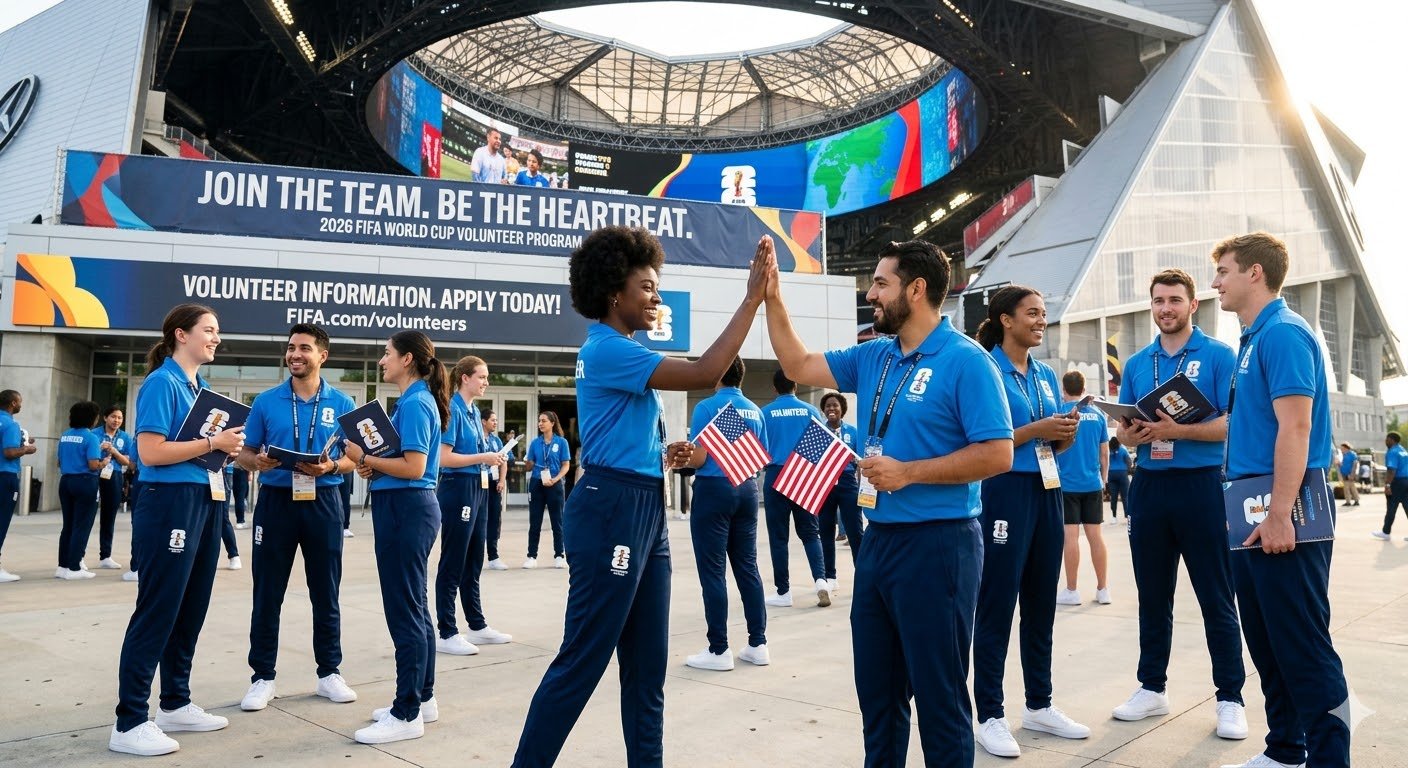
The world of football is bracing for a historic transformation. As the first-ever tournament to feature 48 teams and be hosted across three nations—the United States, Mexico, and Canada—the 2026 FIFA World Cup volunteer program is set to be the largest mobilization of sports enthusiasts in history. This isn’t just a chance to watch a game; it is a once-in-a-generation invitation to go behind the velvet rope and become the “heartbeat” of the most prestigious sporting event on the planet.
- Why Join the 2026 FIFA World Cup Volunteer Program?
- Unparalleled Behind-the-Scenes Access
- Skill Development and Networking
- Cultural Exchange on a Massive Scale
- Key Roles in the 2026 FIFA World Cup Volunteer Program
- 1. Spectator Services
- 2. Media and TV Operations
- 3. Transport and Logistics
- 4. Accreditation and Guest Operations
- 5. Fan Zone and “Last Mile” Support
- Eligibility and Requirements for Applicants
- How to Apply: The Step-by-Step Journey
- Step 1: Join the FIFA Volunteer Community
- Step 2: Complete the Online Application
- Step 3: The Online Assessment
- Step 4: The Interview (Volunteer Tryouts)
- Step 5: Background Checks and Offer
- The 16 Host Cities: Where Can You Volunteer?
- What Perks Do Volunteers Receive?
- Training and Preparation
- Maximizing Your Chances of Selection
- Conclusion
- Frequently Asked Questions (FAQs)
For those wondering how to get involved, the 2026 FIFA World Cup volunteer program offers a unique gateway to professional development, cultural exchange, and the sheer thrill of match-day energy. Whether you are a local resident in one of the 16 host cities or a global citizen looking to contribute, understanding the application process, role requirements, and the scope of this massive operation is essential.
Why Join the 2026 FIFA World Cup Volunteer Program?
Volunteering for a FIFA tournament is a badge of honor that carries weight far beyond the final whistle. The 2026 FIFA World Cup volunteer program is looking for approximately 65,000 individuals to support operations. But why should you dedicate your time to an unpaid position?
Unparalleled Behind-the-Scenes Access
Most fans only see the 90 minutes on the pitch. As a volunteer, you witness the logistical choreography that makes the magic happen. From managing the media tribune to assisting with team arrivals, you are part of the inner circle.
Skill Development and Networking
The program acts as a massive professional workshop. You will develop skills in event management, customer service, language translation, and logistics. Moreover, you will work alongside professionals from FIFA and local organizing committees, building a network that spans the globe.
Cultural Exchange on a Massive Scale
With millions of fans traveling from every continent, the host cities will become melting pots of culture. The 2026 FIFA World Cup volunteer program emphasizes diversity, bringing together people of all backgrounds to “Beat as One.”
Key Roles in the 2026 FIFA World Cup Volunteer Program
FIFA operations are divided into several “Functional Areas.” When you apply for the 2026 FIFA World Cup volunteer program, you may be matched with a role that fits your specific skill set or interests.
1. Spectator Services
These volunteers are the “face” of the tournament. They greet fans, assist with wayfinding inside the stadiums, and ensure that every attendee has a safe and enjoyable experience. If you have a high-energy personality and love helping people, this is for you.
2. Media and TV Operations
For those interested in journalism or broadcasting, this role involves supporting the thousands of accredited media representatives. Tasks include managing the Media Center, assisting photographers on the pitch, and supporting broadcasting crews in the TV compound.
3. Transport and Logistics
A tournament of this scale requires precision movement. Volunteers in transport help coordinate shuttle services for VIPs, teams, and staff at airports, hotels, and stadiums. They ensure that the “veins” of the tournament keep flowing smoothly.
4. Accreditation and Guest Operations
Every staff member and player needs a pass. Accreditation volunteers manage the printing and distribution of these credentials. Meanwhile, Guest Operations teams look after the needs of FIFA delegates and partner organizations.
5. Fan Zone and “Last Mile” Support
Not all the action is in the stadium. The 2026 FIFA World Cup volunteer program also covers FIFA Fan Festivals and the “Last Mile”—the walking routes from public transport to the venue. Here, you create the atmosphere through music, information, and enthusiasm.
Eligibility and Requirements for Applicants
Before you start your application for the 2026 FIFA World Cup volunteer program, ensure you meet the basic criteria established by FIFA.
-
Age Requirement: You must be at least 18 years old by the time the application process concludes (typically by early 2026).
-
Language Proficiency: A good command of English is mandatory. Proficiency in Spanish (especially for Mexico and US venues) or French (for Canadian venues) is a significant advantage.
-
Time Commitment: Volunteers must commit to a minimum of 8 to 10 shifts. Each shift usually lasts between 6 and 8 hours.
-
Legal Status: You must be legally eligible to volunteer in your chosen host country (USA, Canada, or Mexico). FIFA does not generally provide visas for volunteers.
-
Availability: You must be available during the tournament window, which runs from June 11 to July 19, 2026, including mandatory training sessions in the months leading up to the event.
How to Apply: The Step-by-Step Journey
Navigating the 2026 FIFA World Cup volunteer program application can seem daunting, but it follows a structured path.
Step 1: Join the FIFA Volunteer Community
The first move is to create a profile on the official FIFA Volunteer Platform. This is a centralized database where you can register your interest, upload your photo, and list your skills.
Step 2: Complete the Online Application
Once the specific portal for 2026 opens (which occurred in late 2025), you will fill out a detailed form. You’ll choose your preferred host city and rank the functional areas you are interested in.
Step 3: The Online Assessment
After your application is screened, you may be asked to complete an online assessment. This isn’t a “test” in the traditional sense; it’s a way for FIFA to understand your personality, problem-solving skills, and how you handle pressure.
Step 4: The Interview (Volunteer Tryouts)
Successful candidates are invited to an interview, often called “Volunteer Tryouts.” These are frequently held in person at the Volunteer Center in your chosen host city. It’s a chance to show your enthusiasm and meet the local team.
Step 5: Background Checks and Offer
Because safety is a priority, all selected volunteers must pass a background check. Once cleared, you will receive an official “Role Offer.” Once you accept, your journey truly begins!
The 16 Host Cities: Where Can You Volunteer?
The 2026 FIFA World Cup volunteer program is localized within the 16 host cities. You will typically be asked to choose one city where you can provide your own accommodation and transport.
| Country | Host Cities |
| United States | Atlanta, Boston, Dallas, Houston, Kansas City, Los Angeles, Miami, New York/New Jersey, Philadelphia, San Francisco Bay Area, Seattle |
| Mexico | Guadalajara, Mexico City, Monterrey |
| Canada | Toronto, Vancouver |
Pro Tip: Choose a city where you have a “home base” (friends or family), as FIFA does not cover lodging costs for volunteers.
What Perks Do Volunteers Receive?
While the 2026 FIFA World Cup volunteer program is a non-paid commitment, the rewards are tangible and exclusive.
-
Official Adidas Uniform: You will receive a full, limited-edition volunteer kit (shirt, pants, shoes, jacket). This uniform is not sold in stores and is a collector’s item.
-
Meals and Refreshments: During your shifts, you will be provided with high-quality catering and plenty of snacks/drinks.
-
Free Local Transport: Most host cities provide free public transportation for volunteers on their shift days.
-
Certificate of Recognition: At the end of the tournament, you receive an official FIFA certificate, which is a fantastic addition to any CV or resume.
-
The Experience: You get to be part of the “Team behind the Team,” creating memories that last a lifetime.
Training and Preparation
Once you are part of the 2026 FIFA World Cup volunteer program, you won’t be thrown into the deep end without help. The training phase is comprehensive.
-
General Training: An online or in-person session covering the history of FIFA, the 2026 vision, and general health and safety protocols.
-
Role-Specific Training (RST): Deep-dive sessions into your specific job, whether it’s using the accreditation software or learning the layout of the media center.
-
Venue-Specific Training (VST): A final “walk-through” of the stadium or venue where you will be working. You’ll learn the exits, the “hidden” corridors, and where to go in an emergency.
Maximizing Your Chances of Selection
Competition for the 2026 FIFA World Cup volunteer program is fierce. Here is how to stand out:
-
Highlight Languages: If you speak more than one language, shout it from the rooftops! Translators are always in high demand.
-
Be Flexible: While you might want to be on the pitch, showing a willingness to work in Logistics or Transport makes you more “hireable.”
-
Prior Experience: Mention any previous volunteering at sporting events, festivals, or community programs.
-
Enthusiasm is Key: FIFA looks for “sunny” personalities. Your attitude in the interview is often more important than your resume.
Conclusion
The 2026 FIFA World Cup volunteer program is more than just a task; it is an invitation to be part of history. By joining this global community, you contribute to the success of the largest sporting event ever held in North America. From the bustling streets of Mexico City to the high-tech stadiums of Dallas and the scenic waterfront of Vancouver, volunteers will be the ones who turn a tournament into a celebration.
If you are ready to give your time, energy, and passion to the “Beautiful Game,” now is the time to prepare. The world is coming to North America in 2026—make sure you have a front-row seat to the action as a FIFA volunteer.
Frequently Asked Questions (FAQs)
1. Does FIFA pay for travel and accommodation for volunteers?
No. The 2026 FIFA World Cup volunteer program requires volunteers to cover their own travel to the host city and their accommodation. FIFA generally provides meals during shifts and local public transport to the venue.
2. Can I volunteer if I don’t live in a host city?
Yes, but you must be able to arrange your own stay in that city for the duration of your commitment. Most volunteers are locals, but FIFA does accept international applicants who can manage their own logistics.
3. Will I get to watch the matches for free?
There is no guarantee. While some roles (like Spectator Services) might put you inside the stadium during the game, your focus must remain on your duties. Volunteers are not given free tickets to watch matches as spectators.
4. How long do the shifts last?
A typical shift in the 2026 FIFA World Cup volunteer program lasts between 6 and 8 hours. You are usually required to work at least 8 shifts throughout the month-long tournament.
5. What happens if I can’t attend one of my scheduled shifts?
Reliability is crucial. If you have an emergency, you must notify your Volunteer Manager as soon as possible. However, missing shifts without valid reasons may lead to the revocation of your accreditation and uniform.